
Switcheroos
Sometimes meanings change in a way that hinders our learning from past wisdom

Language changes over time. As Sir Terry Pratchett writes in Lords and Ladies:
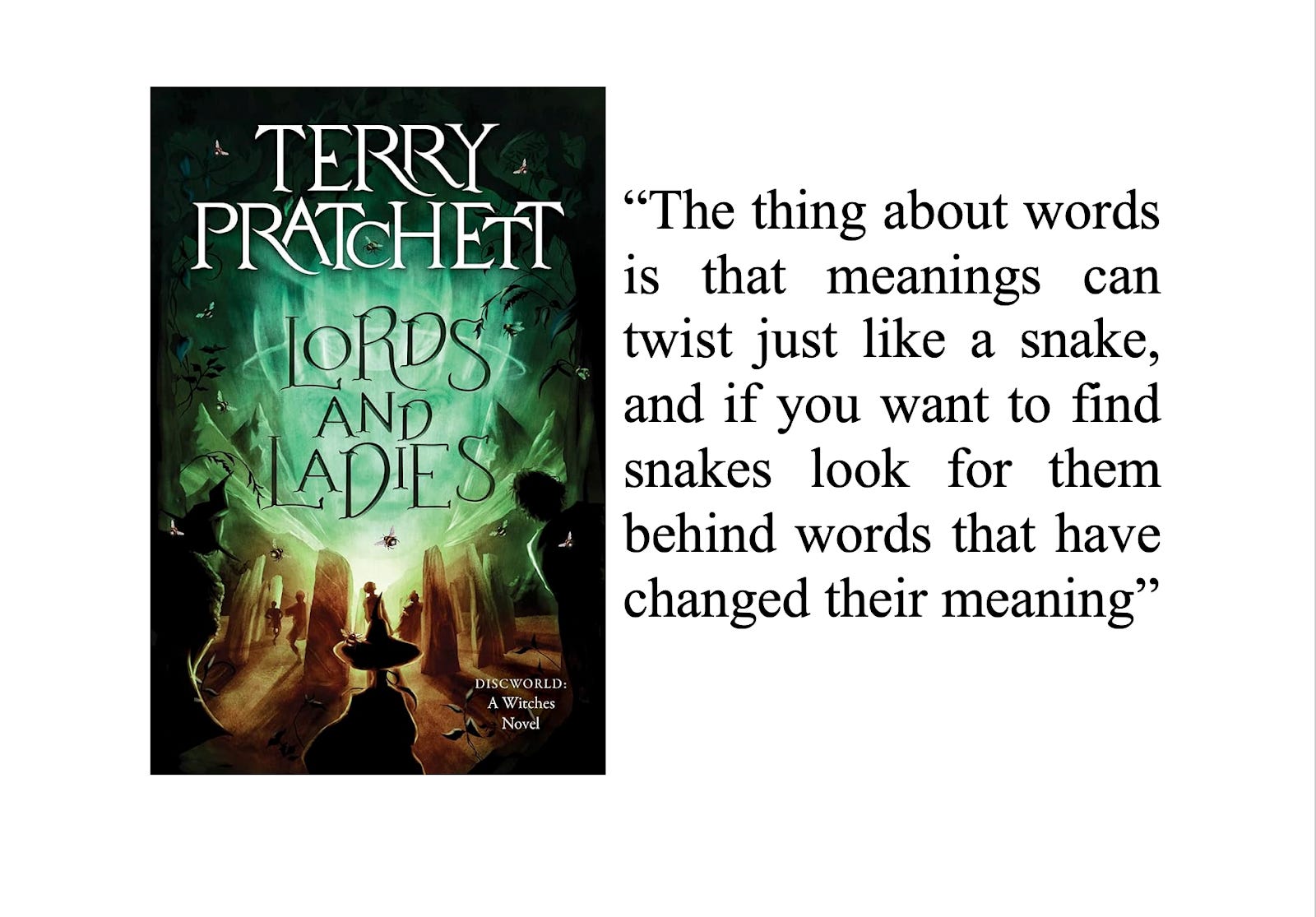
Such change isn’t necessarily a bad thing. But we need to pay close attention to make sure we don’t mistake our forebears’ meanings.
Think of the words used now for groups of people, as opposed to the words used 50 or 100 years ago. The terms that people of good will used in the past can, if you hear them today, make you cringe so hard your toes curl. A charity I knew in St. Louis that collected donations for disabled children advertised their cause on neon smocks, referring to their beneficiaries by the "R" word. When they made those smocks, that was the polite, politically correct way to speak.
We’d be naïve to think that such change won’t come after us, too. Your descendants will say to their friends, “That’s just how my grandparents talk. They are from a different time; their birth year starts with a 1.” Or maybe they will say, “Yeah, they are racist/ableist/sexist for using that word, I’m sorry.” That last response would be a shame. They’d be judging you and your internal states based on your usage of a word that, when you cemented it into your lexicon, had all the markers for being the appropriate and not (say) ableist thing to say.
To get a feel for it, imagine that words like “idiot,” “dumb,” and “stupid” all became as problematic as the St. Louis charity’s old language and ask yourself how well you’d come off if people from that context judged how you speak or write in this context. “Just to warn you, my grandparents are really bigoted; they say ‘d*mb’ and ‘st*pid’ a lot.”
Or think of words that have gone from the correct to the incorrect way to refer to minority groups. John McWhorter has recently argued in the NYT that It’s Time to Let Go of ‘African American.’ Suppose culture follows his lead and fifty years from now that term is seen as a slur. It would be an injustice if our descendants judged Joe Biden or John McCain to be racists solely based on their use of the term.
In such cases, there’s been what we might call a switcheroo.1
Sometimes, a switcheroo happens when a word has its meaning changed to a different moral flavor, after which we understand previous speakers to have been using this new meaning. This is what happens when your granddaughter scrolls through your social media history 50 years from now and sees, to her horror, that you called people ‘dumb’. (I realize this is a far-fetched example; no one will ever look at your posts in 50 years, either because the robots finally got us or because our pictures of dessert aren’t as interesting as we think they are.)
Other times, a switcheroo happens, not when a word’s moral polarity changes, but when its scope gets expanded or contracted. Dolphins aren’t fish anymore (something Aristotle already knew); Pluto isn’t a planet anymore; dog went from naming a particular type to naming a larger group of, well, what we now call dogs.
Switcheroos happen in moral matters, too. The word “obedience” is often used nowadays to name the trait of being a braindead follower, which is then mocked. Thinkers who celebrated the character trait originally associated with the name “Obedience” are now taken to be dopes who really were applauding the sheeple. It went from naming a virtue to naming a liability. There’s been a switcheroo. As a consequence, it has become undersung, a sad status for a virtue to have, which I wrote about in a previous post.
The word “curious” used to refer to the disposition of looking into things that aren’t your business to know. It was a term for a bad character trait – that’s how it got felicide on its rap sheet. Now, though, it is at least neutral, and often seen as a good quality. It went from naming a vice to naming a virtue. There’s been a switcheroo.
Or think of the word “studious.” When you hear that term, you probably think of someone who is devoted to her studies. Maybe the word is nerd-flavored in your mind. The word comes to us from the Latin, studiositas, which can be thought of as the virtue of being properly inquisitive about the truth. Studiositas, in that old sense, isn’t necessarily a library virtue. Detectives and scientists in the lab, decades after graduation or hitting the books, can be studious – in the original meaning of the term. The word’s scope was contracted. If you were to read St. Thomas Aquinas praising studiousness, you’d think he meant hitting the books. There’s been a switcheroo. (For a great discussion of curiosity and studiousness and the history of the terms, see Chapter 3 of Nathan King’s The Excellent Mind.)
These changes in language are expected, and you certainly won’t find me arguing for a return to the old words just because they are old. But notice that we need to be careful in our reading of great thinkers of the past. If we aren’t careful, we will miss out on what they have to teach us, given the switcheroos that have occurred. Looking to the wisdom of the past, which is where the vast majority of accessible wisdom is located, given their head start, will require knowing how they used their terms.
We must be careful about switcheroos. They can be unfair and misleading. And, as Terry Pratchett pointed out, dangerous.
In some following posts, I’ll discuss some terms that have undergone switcheroos, starting with lust.
I owe this term to my dear friend, Hud Hudson.