
Undersung Virtues
Tim's Book Project

This post describes a popular book project Tim’s working on. (Popular as in not just for professors, though I wouldn’t mind it being popular in the other sense, too!)
I discuss the project here with Fr. Gregory Pine from the Thomistic Institute. The link takes you to the relevant part of the discussion, but I’d not be offended if you listened to the whole thing.
The Premise: No one wants to be (or to have) an ungrateful child, an unfaithful spouse, or a wrathful boss; indeed, we ardently desire the contrary qualities: gratitude, faithfulness, equanimity. But, as I argue in this book, our contemporary views of character are stunted; we don’t have a good understanding of the virtues we want to instill, and we don’t know how to go about inculcating them. The purpose of this book is to re-represent the underappreciated virtues with equal doses of humor and gravity, showcase their value, and provide guidance for their cultivation.
All loving parents want their children to have the character strengths required to say no to pleasure when it gets in the way of wellbeing, say, by being responsible with alcohol. All spouses want their partners to have the character strengths required to say no to sexual temptation when on a business trip. All coaches want their players to have the self-discipline required to control their temper on the field. Indeed, everyone, everywhere, at every time, has wanted the people they love to be strengthened against such ethical liabilities. If you ask yourself honestly, you’ll see that such traits are things you deeply desire, both in yourself and in those you love.
For being so deeply desired, though, we have a grave moral illiteracy about such traits. As David Brooks writes,
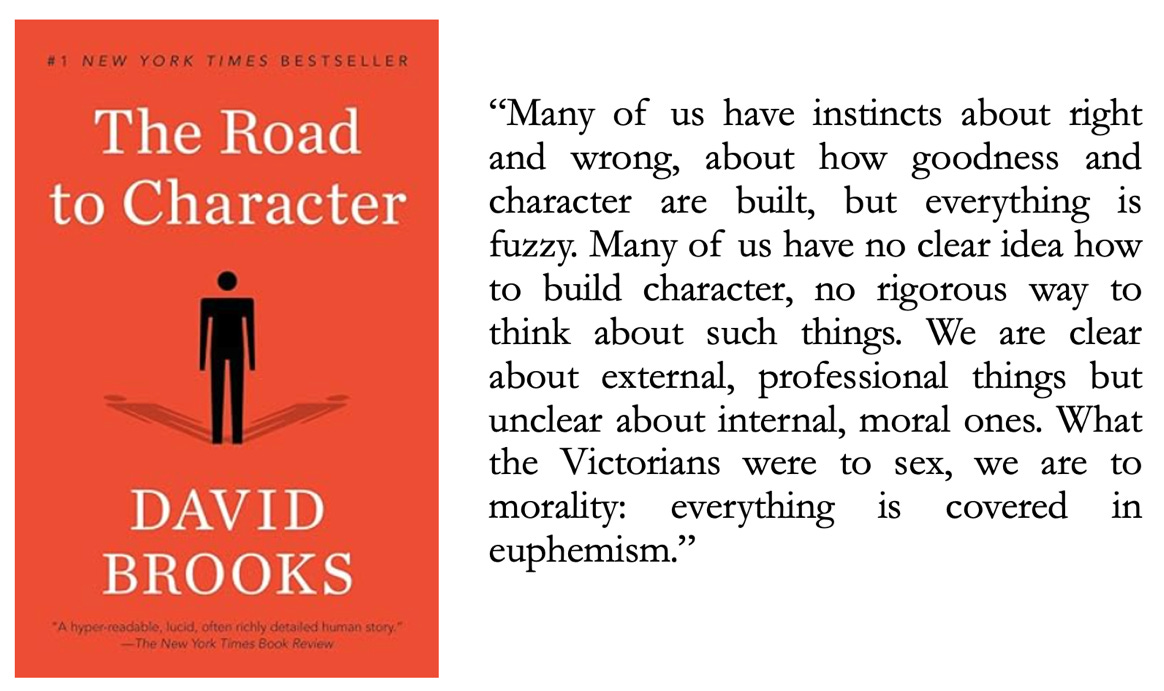
I think he’s right. To see why, reconsider the examples I gave: what do we call the character strength that is excellence with respect to intoxicants, or with respect to sexual appetites, or with respect to controlling our anger? I don’t think that we have common terms that capture excellence with any of these.
Aside from a mere lack of names, how should we conceptualize those traits? What does, say, gratitude amount to? And what does it require of us? And how do we go about forming it? If you want to form yourself (or your children, or players, or students, or clients, etc) to have good character, you must understand what it is that you are aiming at.
We have an ardent desire for a great good, but no clear notion of the goal and no viable path to attain it.
Let’s focus for a moment on one of the three traits discussed above. Consider the harms caused by overconsumption of alcohol. Such ills have their origin in excessive desire for intoxicants. What’s a corrective for such inordinate desire? If “drunkenness” is the name for the excess, what’s the title we give to the related virtue? It used to go by the name sobriety. I know what images the term conjures up now– the American Temperance Society, teetotalers with frowns of condescension, etc. If that’s what our intellectual forebears meant by the term sobriety, then I’d agree that it is an unlikely corrective to these problems. But that’s not what they meant.
One is sober, in their sense, when one appreciates and uses intoxicants in accord with right reason. Understood as such, the concept is a useful moral diagnostic tool and motivating goal, something we desire for ourselves and those we love. We don’t currently have such a notion in our conceptual arsenal; the closest we come is “drink responsibly” hidden away from the hotrod or pool party at the bottom of beer ads. We can reclaim the wisdom of our predecessors and in doing so benefit our character and the character of those in our care.
What we have is a conceptual vacuum. Our moral diagnostic machinery has been diminished to our detriment. There was a perfectly good term for the virtue we hope to instill in our children as they come to drinking age. We want them to be the sorts of people, deep in their bones, about whom we don’t have to wait up at night wondering whether they are making decisions with intoxicants that will be ruinous to their lives or the lives of others.
We recognize that the trait we used to call sobriety would be an excellence, and that the lack of such a trait – or worse, the presence of a stable disposition to imbibe too much – would be a great detriment to one’s wellbeing. It would be a grave moral liability.
Once you start looking, you’ll see more gaps in our shared moral conceptualizations - What term do we have for being excellent in response to anger, for being disposed to pick one’s battles prudently, not letting anger cloud one’s judgment, not being easily baited, but also not being easily biddable, or callously impassive to the real injustices that rightly cause our anger? Such an excellence was once called meekness, but now that term has been reassigned to the mousy, timid doormat, sheepishly acquiescing to injustices. And what term do we have to replace it?
Or what term do we have for being disposed to act excellently with respect to one’s sexual appetites, for being disposed not to be led by one’s pants into foolish situations, not to be easily manipulatable, but also not being ashamed of or embarrassed by the real goods involved in sex? It was once called chastity, but now that term has been shifted to refer to the prudish, sexually repressed, purse-lipped killjoy. What term has come to replace it?
Those terms have been transferred from their posts, and no reinforcements have been sent. How can we fortify our moral lives without even having the right map of the battlefield?