
Envy
7 Deadly Sins Post #8

Think back to the days of your youth, when you’d spend a holiday with your extended family. It’s Thanksgiving, say, and you and the cousins are overrunning grandma’s house. There’s a steady stream of rampaging and yelling small humans. It’s like someone started a conga line at a death metal concert. A few years ago, you would have been part of those shenanigans. But you and your cousin cohort have aged out of the more physical displays of prowess.
Over the din, Grandma asks your cousin about her summer plans, and she launches into an excited retelling of some great news she recently heard. She’ll be an intern at an urgent care veterinary clinic! Since elementary school she has dreamed of being a veterinarian, and this is a wonderful step in that direction. Moreover, she continues, Ben, her longtime boyfriend, was hinting at an engagement. Your hand tightens on your glass, and you freeze your face into that “oh, how wonderful for you!” look those runners-up in beauty competitions wear. Maybe she’ll have more news come Christmas! Grandma beams. She clasps her hands together in front of her chest in that way she has, and her eyes glisten with imminent tears of sheer, unadulterated joy. Joy for your cousin.

She turns to you and asks about your summer plans. You gesture toward some things that still might come through, even though, in your heart, you know that this will be another retail summer at the mall. Which is fine. It is fine! But Grandma doesn’t have a drawing you made of your lifelong goal of folding smocks, like the one your cousin drew for her, where she’s standing next to that freakshow of a horse with legs of four different lengths. That stupid horse could use some urgent care.
Now, you love your cousin. Of course you do. Of course you do! That goes without saying. You’d do anything for her. You’d have slashed the tires of the other internship finalists’ Subarus if she had pulled a page from Ben’s playbook and hinted at it. But—and this is a very small but, something Sir Mixalot wouldn’t write a lyric lauding—couldn’t she just, I dunno, shut the hell up about how great everything is going for her?
It isn’t even that you want what she has. You know that you’d hate that internship, with those poisoned dogs or bleeding cats. And she can certainly keep Ben. What you want, if you are really honest with yourself, is for her success not to reflect so negatively on you. It isn’t that she is flourishing in order to make you feel bad. It’s just that her flourishing does, in point of fact, make you look less good than you would otherwise look. If she weren’t here, you’d be the grandkid with the most stuff to strut. Her looking so good makes you look less good, and that makes you sad.
We’ve got a word for what you’re feeling, but you aren’t going to like it. You are Envious.
What Is Envy?
Aquinas begins his discussion of Envy as follows:
“envy is sadness at the glory of another as conceived to be an evil” (De malo q.10 a.3 resp)
What is it to be “conceived to be an evil?” Aquinas, no one will be surprised to hear, distinguishes varieties of sorrow at another’s good. For instance, if your enemy has acquired another terrible weapon, you both judge what he has received to be a good thing (you’d certainly want it for your side) and at the same time, you sorrow at his having it. But such sorrow isn’t envy! It isn’t his outshining you in military might that makes you sorrow; it’s that he can hurt you and people you love that causes your sadness.
When does your sorrow slide into envy? Aquinas discusses this most explicitly in his Summa Theologica. There he writes:
“another’s good may be reckoned as being one’s own evil, insofar as it conduces to the lessening of one’s own good name or excellence.”
It is when you see her good internship as making your luster less luminous that your sorrow turns to Envy.

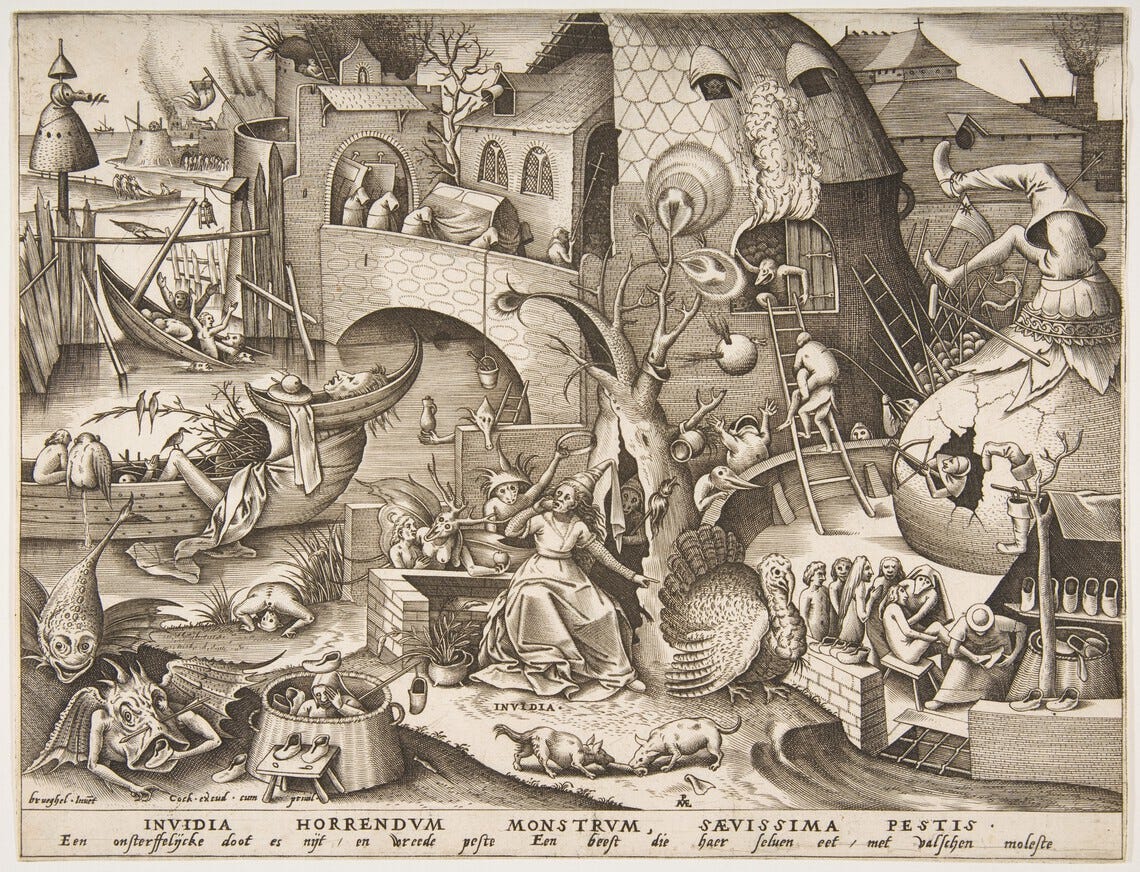
Digression: I love this painting. Look at everyone; they’re all wanting something someone else has. The brown dog, he wants the other dog’s bones. The other dog, he wants the man’s bone. The man with the bone and the woman next to him: they want the bird. Can’t you just hear them?
He says, “oh, he’s back with that bird again. Gosh, check it out.”
And she’s all like, “lemme see. What a lucky devil, with that bird. What I wouldn’t give for a husband with a bird like that.”
“…what?”
Even the guy with the big bag on the right. Look at his eye, between his elbow and the bag. He knows where the fancy bird is!
Aquinas relates Envy to other attributes in his discussions. For instance, he discusses its relation to Charity, to Pity/Mercy/Compassion (Latin: misericordiae), and to something he calls, following Aristotle, Nemesis. (Hint: he doesn’t define it as Alan Ford’s character Brick Top defined it in that cinematic masterpiece, Snatch).
Envy and Charity agree in their object: the good of one’s neighbor. But they disagree on the sort of emotive response one has to that good, the passional polarity, if you will. Those with Envy sorrow at their neighbor’s good; those with Charity rejoice at their neighbor’s good.
Envy and Pity agree on their passional polarity: both involve sorrow at the state of one’s neighbor. But they disagree on the object of that sorrow. The Envious sorrow at the neighbor’s good; those with Pity sorrow at his evil.
Envy and Nemesis agree in their passional polarity: both involve sorrow at the state of one’s neighbor. But the justification for that sorrow differs. The Envious sorrow because the neighbor’s good makes them look less good, redounds negatively upon their own good name. Those with Nemesis feel sorrow because the recipient of the good is unworthy to receive the good. Aristotle thought that such sorrow was part of good morals. It seems to me that Immanuel Kant might agree, as he writes:
“The sight of a being who is not adorned with a single feature of a pure and good will, enjoying unbroken prosperity, can never give pleasure to an impartial rational spectator.”
Nemesis, in this sense, isn’t being someone’s archenemy. Nemesis is that feeling you have when you are saddened by someone unworthy receiving a good thing.
Why is Envy Ranked as it is?
One way to differentiate the gravity of the Deadly Sins is by measuring the distance between what one’s heart is set upon and what it should be set upon. Remember our buddy Bob, whose arrow shows what he has his heart set upon. When last we checked, we saw that Bob’s heart wasn’t set upon God. Indeed, it wasn’t set excessively on any particular good: not sex or food or money. It wasn’t even, like the Slothful, set on unwanting a good. Bob was Wrathful when last we checked in. He looked like this:
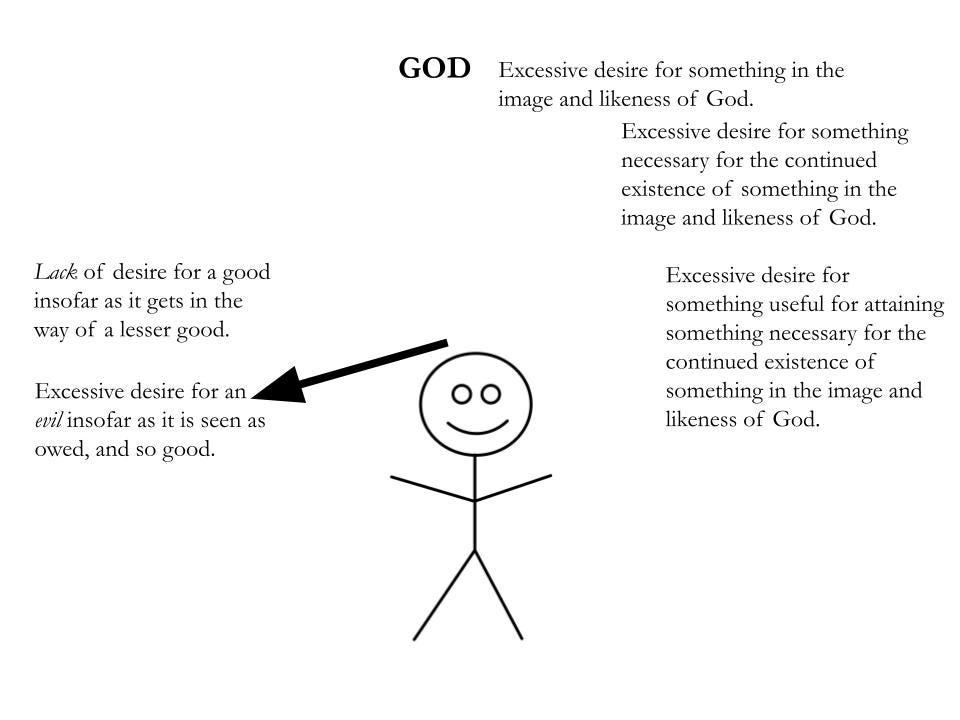
His heart was set on something evil, but at least we can say that he viewed that evil thing as a good in his judgment. For instance, maybe he judged the excessive vengeance as being owed, and so, as owed, good.
Now, though, Bob looks like this:
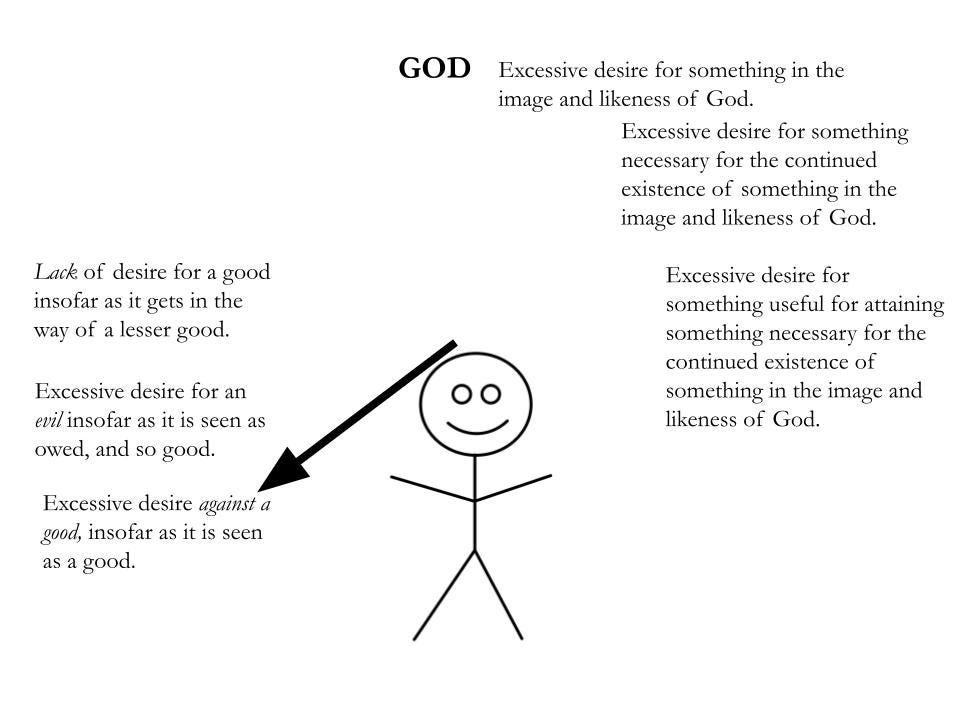
Now, as envious, Bob has his heart set against a good. And it is set against that good precisely because it is a good! He judges it rightly – “that’s good!” – and yet he still desires against it. And why? Not for any noble reason. Not because it is contrary to the safety of those he loves. Not because the recipient is unworthy of the good received. He desires against it because, with that guy having that feature, Bob looks less impressive than he otherwise would. Envy is a small-making feature in a soul.
Envy’s Daughters
Gregory the Great lists five daughters for Envy. They are:
1. Hatred
2. Tale-bearing
3. Detraction
4. Joy at our neighbor’s misfortunes (Schadenfreude)
5. Grief for our neighbor’s prosperity
As with previous lists of daughters for the Deadly Sins, we might be perplexed here. Can’t Avarice cause hate just as well as Envy? If so, why does Envy get to call dibs on hatred? Moreover, as Aquinas himself considers, isn’t grief at our neighbor’s prosperity the same thing as Envy itself? But then, how are Envy and grief for our neighbor’s prosperity related as parent and daughter? A daughter can’t be her own mom, can she, no matter how much ingenuity Robert Heinlein shows in “All You Zombies”?
Here’s how Aquinas sees things. He divides the struggles we have with Envy into those that arise at the outset, the middle, and the culmination of the Envy.
At the outset, when first learning of the relative greatness of the other person compared to us, we often try to lower that person’s status. If we do it in secret, it is tale-bearing; if in public, it is detraction. If you wait until your cousin walks away to whisper to Grandma that your cousin has a drinking problem, you are tale-bearing; if you instead clink your glass at dinner and stand to make a speech, informing the whole family, it is detraction. (For more on detraction, as well as a thomistic analysis of other sins of speech, check out my recent Thomistic Institute Substack post.)
In the middle, our attempts to lower their status have either been successful or they have not. If they have not been successful, we have grief for our neighbor’s prosperity. If they have been successful, we have joy at our neighbor’s misfortunes.
Finally, in the culmination of our Envy, we find hatred. It isn’t hard to see how hatred follows from Envy.
What’s that? You’d like a hierarchical representation in pictorial form? Mmmmokay!
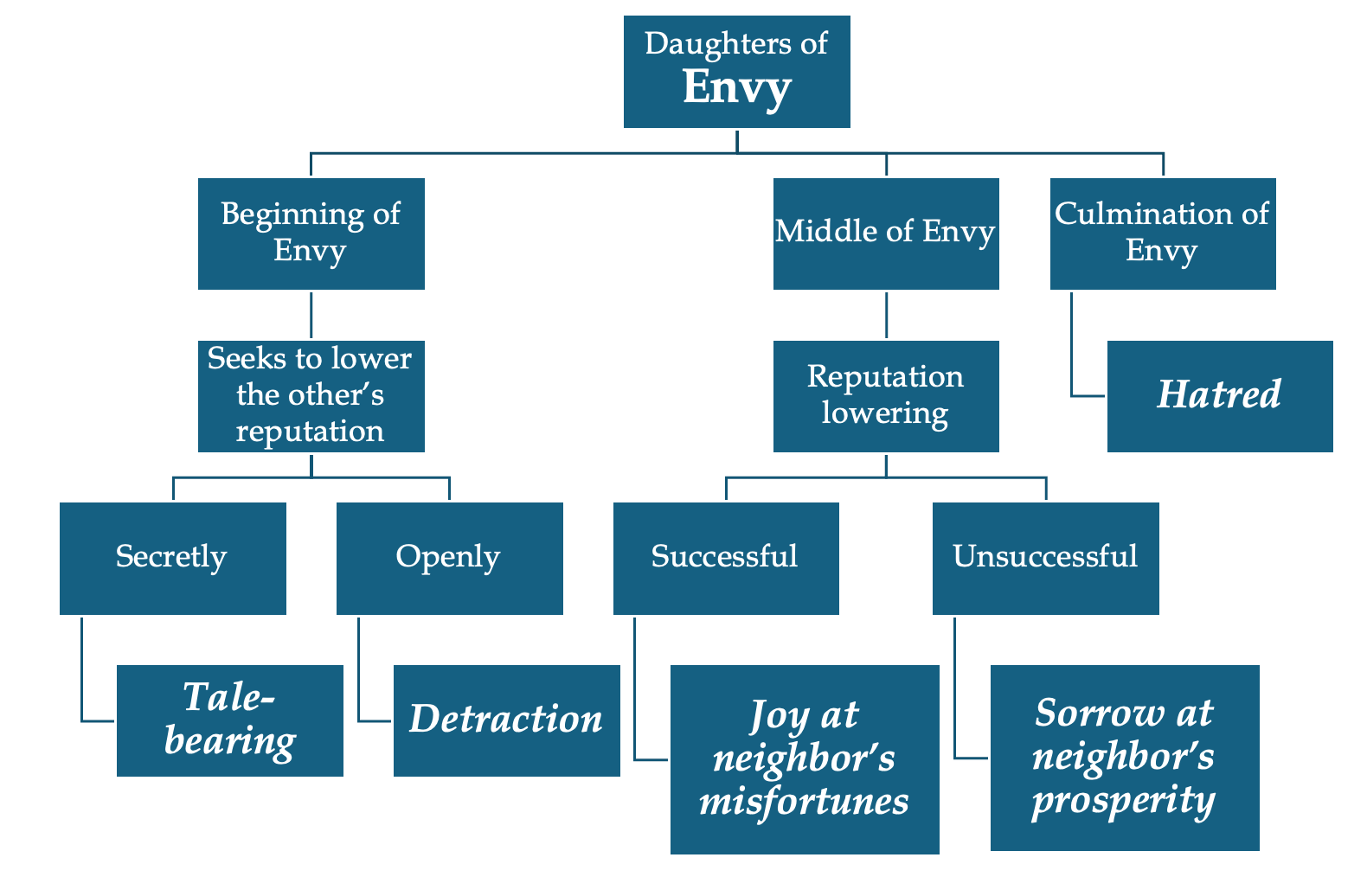
Circle back to the question of how the daughter, grief at the neighbor’s good, is distinct from the mother, Envy. Understood merely as when “a man grieves over another’s prosperity, insofar as it gives the latter a good name” Aquinas says that is “the very same as Envy.” Aquinas says that grief becomes a daughter of Envy when, after attempting but failing to ruin their prosperity, we sorrow. To see the wisdom here, return to the initial example.
You feel Envy at your cousin, which leads you to whisper an unpleasant truth about her to your grandmother. But your grandma, wise woman that she is, sees through it entirely, gives your hand a little squeeze, and says, “Sunshine, your time will come, too.” She then gets up to go supervise in the kitchen. At this point, your sorrow at your cousin’s fortunes has compounded. Your envy led to sinful action, which, failing, led to more sorrow at the neighbor’s (cousin’s) prosperity.
Next time we move on to the next sin in order of gravity: Pride/vainglory, the very worst of the deadly sins.
Stay tuned.
Hi Mr. Pawl, I just wanted to say I am struggling with envy right now and this was tremendously helpful. I just went through a breakup and am feeling very lost in life while all my friends are engaged, getting married, and having kids. I feel so behind in life and I feel like the longer I wait I will never get a partner who would work well with me. I've questioned a lot of things but your writings on catholic philosophy, faith, and science have been of tremendous help to me. I am trying to have faith every day and I just wanted to thank you for that!