
Wrath
7 Deadly Sins Post #7

I was once driving to pick up a friend to take her to the Mayo Clinic for some appointments. We had a brutal snowstorm the night before, and so while the day was bright and clear, the roads were piled high with snow. Neighborhood streets, like hers, were just about impassable, especially for a little Subaru Impreza like ours. There came a point at which I was stuck – again! – and after rocking the car back and forth a bit, I had to gun it to get out of the ruts. I looked for cars, but somehow missed the white, that is, in this context, camouflaged, car approaching. In that weather, I would have had a better chance of seeing Wonder Woman’s jet. The dude honked, did some impressive maneuvers, and thankfully dodged the Impreza missile I had launched at him.
He was, shall we say, not happy. He got out screaming and cussing, menacing as he approached. I thought he was going to pull me out of my car. I think what stopped him were my unexpected replies. “Yes, you are right; I’m sorry.” “I know; I agree.” “I should have been more careful.” Momentarily disarmed by my remorse, he stalked back to his car and sped off. I say “momentarily” because only a short while later I saw in a neighborhood Facebook group that a man had pulled a gun on someone that morning in a traffic altercation. You can guess who was in the accompanying picture. (It wasn’t me.) True story.
Surely you know your own stories of wrath, of anger way out of whack. You’ve seen kids rage-quit their homework in frustration, fistfights in bars, irate players ejected to the detriment of their teams. You’ve heard, likely said, words in anger that can’t be unspoken. Such excessive anger is a moral liability. It is a detriment to the good life. It enslaves your reason to your base passions. Aquinas thought that a habitual disposition to such excessive anger was a deadly sin - the sin of Wrath.
What Is Wrath?
Aquinas gives a seemingly disjointed definition of Wrath, here referred to as Anger (“Wrath” and “Anger” are both words used to translate the Latin “Ira”):
Anger is a sin when one inordinately desires vengeance, or because one seeks vengeance contrary to what the law prescribes, or because one seeks vengeance with the aim of doing away with the sinner rather than the sin. (De malo q.12 a.1 resp)
Here Aquinas lists three conditions for sinful wrath. They each agree in that there is something excessive related to vengeance, something carried away about it.
The first concerns situations in which you perseverate on vengeance. Thinking about it consumes you. It’s the desiring that is overboard.
The second concerns desires for vengeance that are contrary to law. Vigilantes are a good example of this, as is the guy with the gun during the snowstorm, seeking his vengeance contrary to law.
The final concerns desiring excessive punishment. Sometimes someone you love undergoes an injustice and your immediate desire is something way out of proportion to the dictates of justice.
Aquinas draws some important distinctions concerning wrath, the most important of which has to do with the state of one’s intellect. The main question is this: do the material manifestations of anger come as a result of your rational judgment of the situation, or do they come first, hindering your ability to judge rightly?
Anger that comes after the judgment is called consequent wrath, since it is a consequence of the judgment. Such anger is useful, as it can motivate you to do what you need to do. Think of how being angry can gird you to do hard things for the sake of justice, for instance, enduring the inclement weather during a stakeout, say, to see who’s been stealing your packages. Or more seriously, think of how consequent wrath could help motivate a sentry to stay awake on watch, or a detective to face danger to locate the kidnapper.
Anger that comes before your rational parts can weigh in is called antecedent wrath, since the wrath comes before (ante) the judgment. An inclination to such wrath is a liability. How often have you heard – or had to say – something like this:
“I’m sorry; I just heard what he said, took it the wrong way, and blew up on him. I didn’t stop to think about it.”
It is a liability when anger clogs up your intellect, sloshing your reactive options over to the primal murder center of your brain. (That’s how brains work, right?)

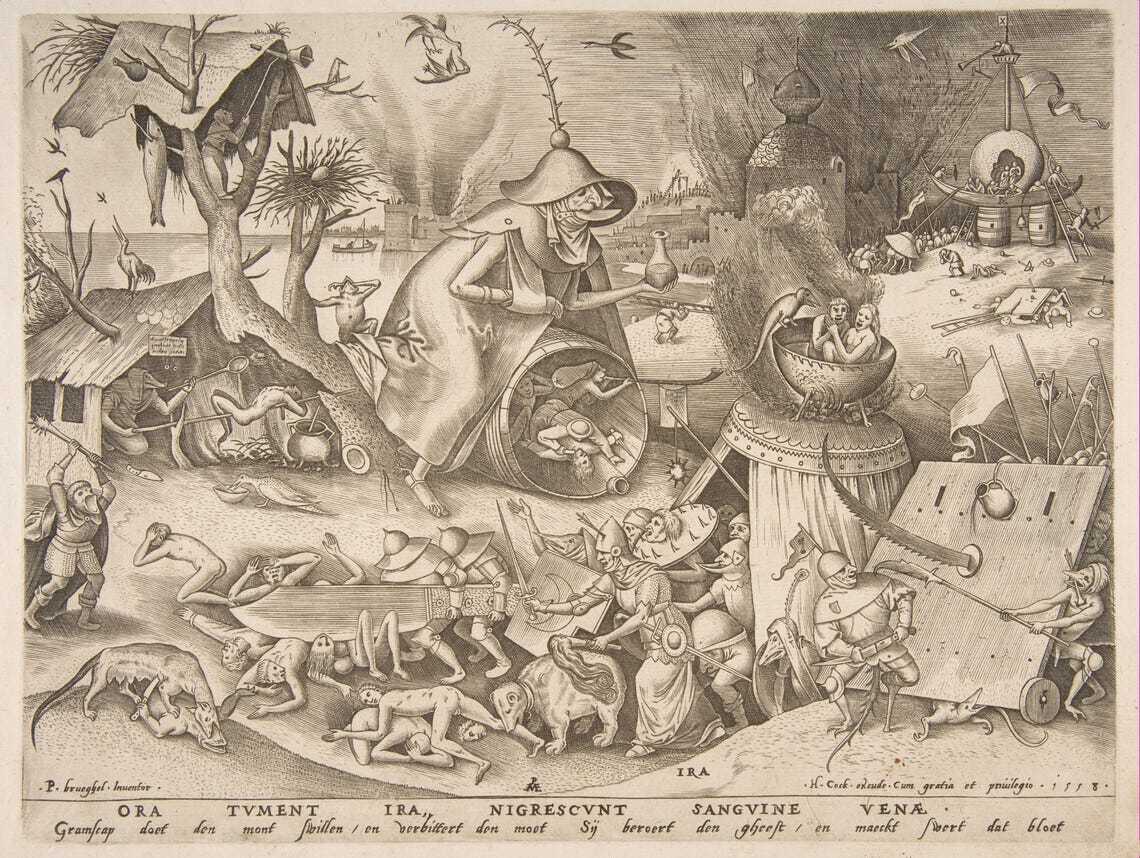
Digression: I love this painting, in part because of what it reveals about human nature, and in part because of its inexplicability. Why is that guy wearing a three-sided table on his head like it’s a prototype of a tricorn? Also, check out the feet in the picture. The men are clearly wearing shoes. And so that pair of white, pokey shoes must be the woman’s. This tells us a deep truth about the human condition: For centuries, woman have been kicking off impractical shoes before throwing down. You probably thought someone in your high school invented the maneuver. I bet the only reason there aren’t any dangly earrings on the ground, too, is that her wimple protects her lobes. Maybe that’s a wimple’s original purpose?
Why is Wrath Ranked as it is?
You might think that Wrath is always a sin. But in truth, Aquinas thinks that the Christian oughtn’t issue a blanket condemnation of anger. For whatever Christ did, he did virtuously and without sin. But he was angry, for instance, when he ran the moneychangers out of the temple with a whip. Thus, at least sometimes it is virtuous and not sinful to be angry.
Aquinas quotes St. John of Damascus often on this point. Indeed, St. John goes so far as to say that not only is some anger virtuous, but some lack of anger is sinful! As Aquinas provides the text:
Chrysostom says: He who is not angry, whereas he has cause to be, sins. For unreasonable patience is the hotbed of many vices, it fosters negligence, and incites not only the wicked but even the good to do wrong.
When does anger go from virtuous and obligated to vicious and prohibited? When it crosses one of the three thresholds that Aquinas set up in his above definition. When does it become a Capital Vice/Deadly Sin? When, as we’ve seen previously, the stable disposition to cross those three thresholds begins subordinating other sinful activity on the person’s part; that is, when he starts doing other sinful acts motivated by his wrath. Say, he lies to the police in order to get vengeance on a rival.
One way to differentiate the gravity of the Deadly Sins is by measuring the distance between what one’s heart is set upon and what it should be set upon. Remember our buddy Bob, whose arrow shows what he has his heart set upon. When last we checked, we saw that Bob’s heart wasn’t set upon God. Indeed, it wasn’t set on any particular good. Being Slothful, his heart was set against the good. He unwanted the higher goods in favor of some lower good or other. He looked like this:
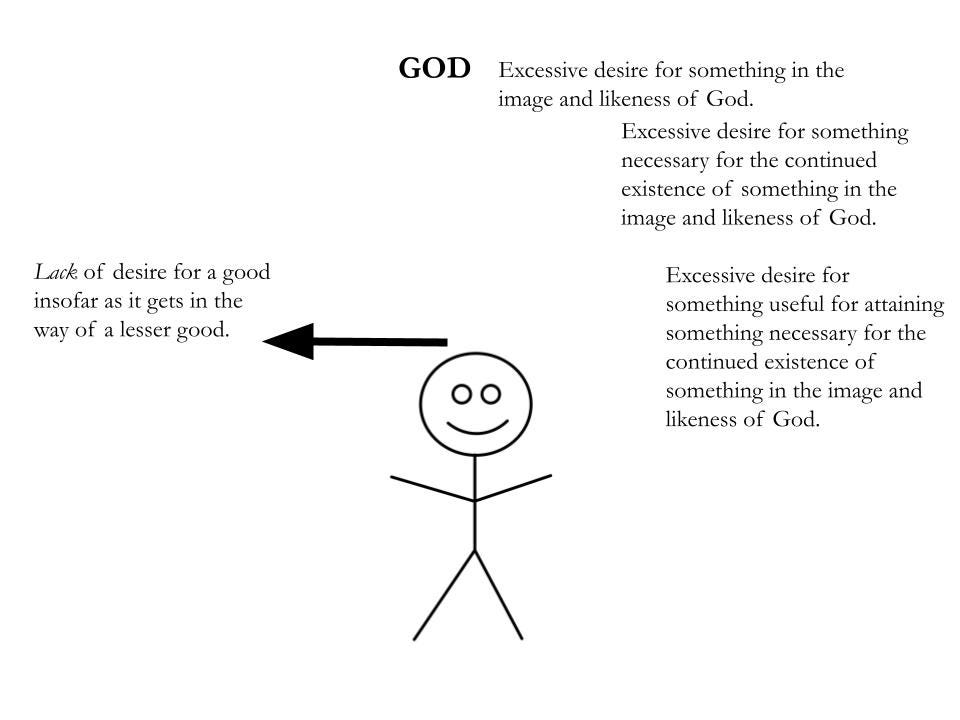
Bob’s ultimate good arrow was not set upon God, the genuine ultimate good. Moreover, he had descended beyond the sins of excessive love, of inordinately wanting the pleasures of sex, or of food, or of instrumental goods. In that respect, the state of Bob’s heart was far removed from where it should be, stuck in a state of defective love.
Now, though, he’s gone even farther into the depths. For, now he is in a state of distorted love, love overrun its proper boundaries. He looks like this:
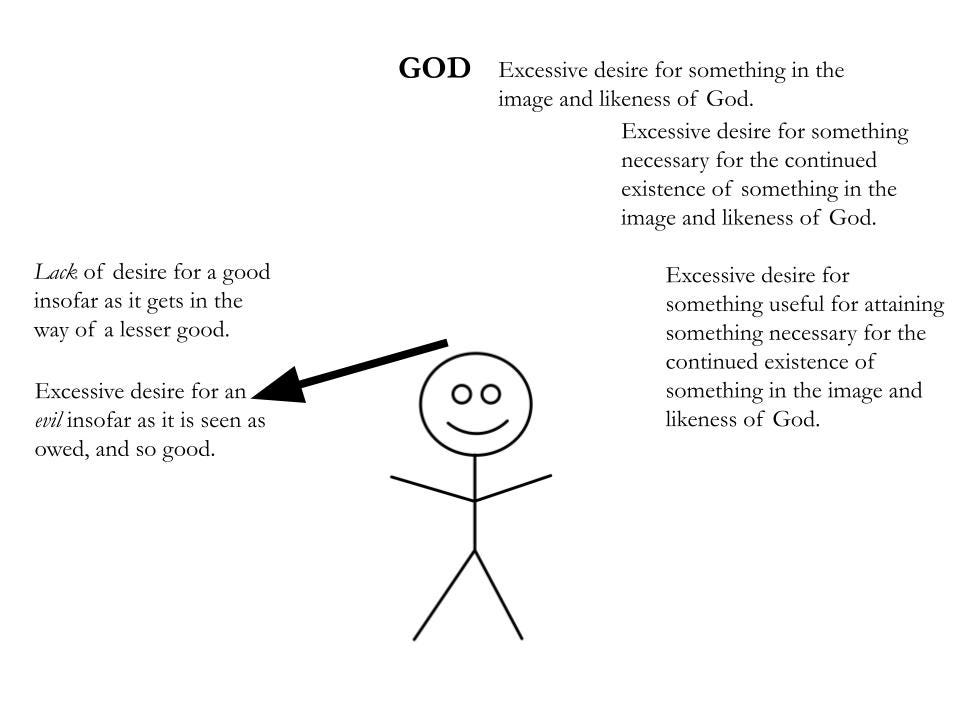
He’s got his heart set on something evil. But at least, to his credit, he mistakenly believes that it is not evil. As we move on to Envy and then later to Hatred, we’ll see that Wrath is less bad than those two traits precisely because of this mismatch of desire and judgment.
Wrath’s Daughters
Gregory the Great lists six daughters for Wrath. They are:
1. Quarrels
2. Inflated Ego
3. Insults (Contumely)
4. Exclamations (Clamor)
5. Indignation
6. Blasphemies
As with previous lists of daughters for the Deadly Sins, we can understand why some request paternity tests. For just one instance, doesn’t Inflated Ego resemble Pride more than Wrath? Why, then, would we find Inflated Ego here?
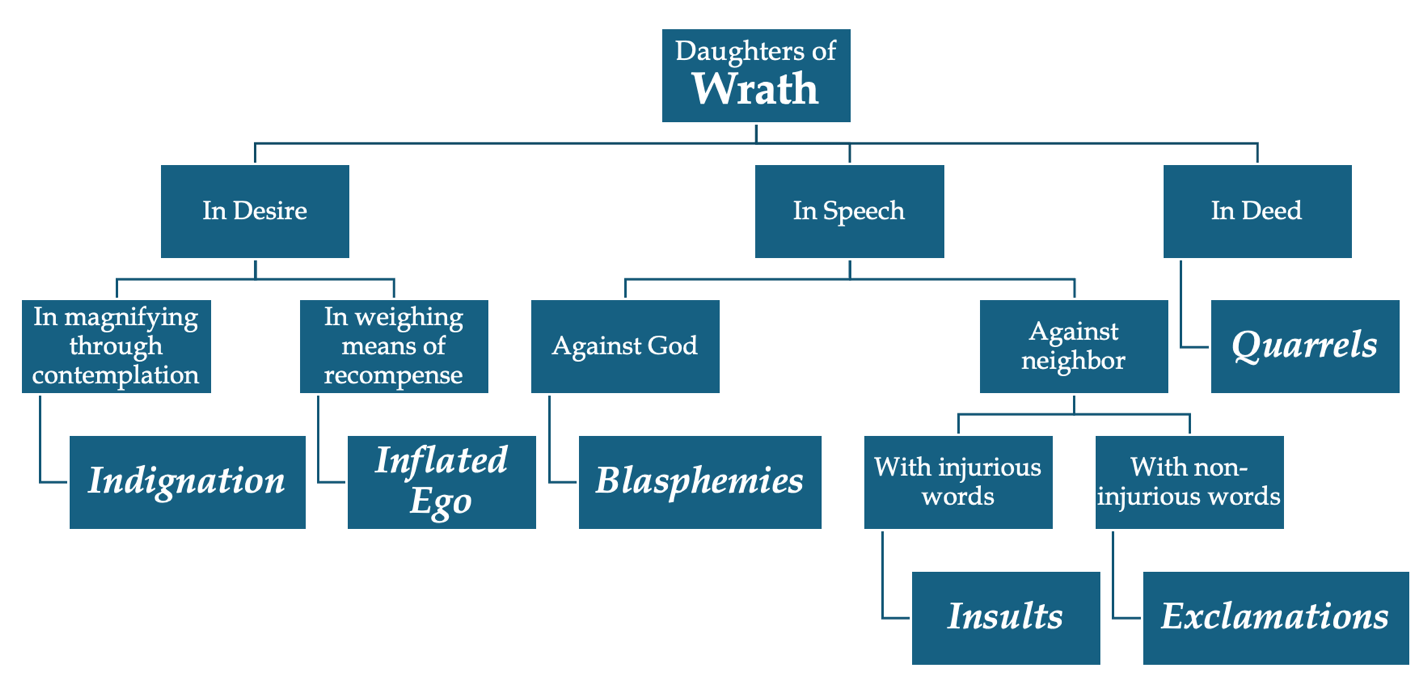
Again, Aquinas has an account of why Wrath procreates such progeny. Wrath manifests itself in desire, speech, and deed.
In desire, we can find ourselves fuming at the indignity of it all, in which case we have Indignation. Or we can find ourselves ruminating on the various ways we’ll correct that ne’er-do-well. Maybe I perpetually return to the thought about how I’ve been wronged, how I didn’t deserve that, how I am owed… I, I, I… in which case we have Inflated Ego.
In speech, our anger can lead us to rash speech against God, in which case we have Blasphemies. Concerning our neighbors, our wrath might lead us to speak injuriously toward them, in which case we have Insults. Sometimes we blurt and burst from our wrath with “disorderly and confused speech”, but not with injurious words, in which case we have Exclamations.1
Finally, concerning deed, when our wrath leads us to act out against others in vengeance, this leads to Quarrels between the parties.
Let’s put it in a hierarchy!
Next time we move on to the next sin in order of gravity: Envy, in which we desire that someone else lack a good precisely because it is good. Stay tuned.
In the Summa, Aquinas divides these divisions slightly differently, primarily by dividing the daughters in speech first by whether the words are injurious or not. If they are injurious, they are either against God (blasphemy) or against neighbor (contumely). If they are non-injurious, they are clamor.