
Sloth
7 Deadly Sins Post #7

When you think of Sloth, you probably think of someone in a hammock, lazily sipping a rum drink, while others scurry around doing his work for him. Or maybe you think of a dude in his mom’s dank basement, stained white tank top exposing an unmanageable muffin-top, pwning the noobs on some mmorpg. I bet you don’t think of an overworked businesswoman with a calendar full from morning to night, every minute accounted for. But, in reality, each of these three can serve as an example of the traditional notion of Sloth, since that vice is less about the amount of activity one undertakes, and more about one’s level of desire for the higher goods in life.
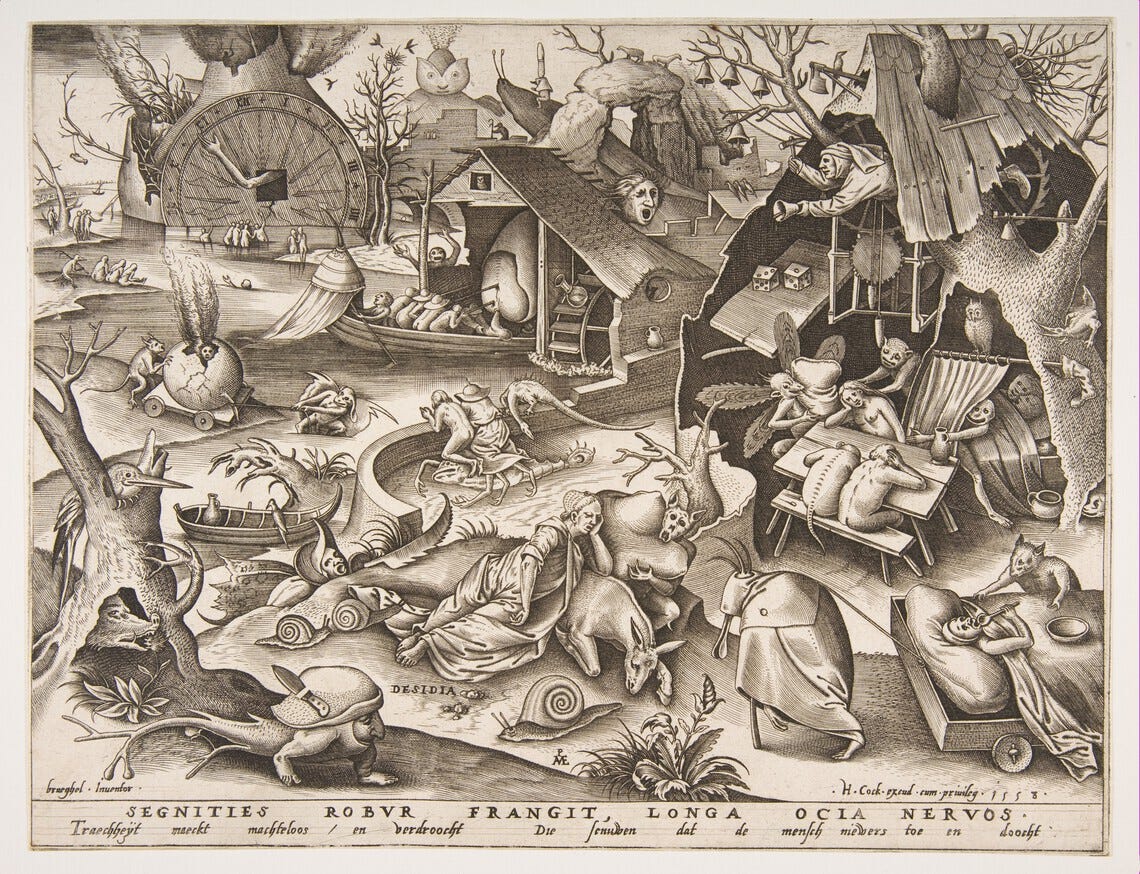
What Is Sloth?
Aquinas writes of Sloth, which is sometimes called “spiritual apathy”:
Spiritual apathy consists of boredom or sadness regarding a spiritual and interior good, as Augustine says…insofar as it is contrary to carnal desires. (De malo q.11 a.1 resp)
You hear “carnal desires” and think sex stuff, but it is broader than that. Any bodily pleasures – from snuggling under warm blankets on a cold morning to eating something delicious – qualify.
Aquinas describes it again as follows:
Spiritual apathy signifies a sadness arising out of the repugnance of human desires for divine spiritual good. (De malo q.11 a3 resp)
Boredom? Sadness? This doesn’t sound like Sloth! I’ll return to that worry in a moment. But first, let’s recognize that we do see this sort of misordering and lack of desire for a higher good in many situations.
You know this from mundane things in life. The middle-aged man wants to follow the doctor’s orders and lose some fat. But he continually finds himself spurning that higher good, preferring goods he fully believes are lesser than the good of health. He sorrows over having to do the thing that he knows is the better path, insofar as it gets in the way of the lower path, with the pleasures he’s become accustomed to therein.
Now, change the subject so it is a higher good. You are seeing someone seriously and his parents speak a different language. You want to learn to talk to them, to foster community with the people most important to your beloved, but the process of language acquisition so is hateful. It isn’t that you have an overpowering desire for some specific good that vocab study hinders; it’s that you entirely lack the gumption to act for the higher good, in light of the lower goods you’ll miss in doing so. Maybe relaxation, or mental tranquility, or more YouTube.
Now consider an even higher, spiritual good. Maybe you want to bolster your prayer life in order to grow in your faith. But the idea of getting up earlier to read scripture is a pain. Or you’ve got a prayer group meeting that evening, but you’d rather stay in than go out into the Minnesota February evening, -30 degrees and pitch black at 7pm.
In each of these three cases, there’s a higher good you know you should seek. But it is in conflict with some lower good, and you are frustrated that the lower good is bumped out by the higher one. Your desire for the higher goods is paltry. It gets swamped by your desires for the lower goods in conflict with it.
Importantly, it isn’t some specific lower good of which you are excessively desirous that is the problem. Were that the case, we’d still be in Dante’s realm of excessive desire for the good. It would be Lust or Gluttony or Avarice or something else like those. No; it isn’t that you want some specific lower good too much, your problem is that you unwant the higher good too much. As such, any of a number of lower goods would be equally choiceworthy, in your estimation, over the higher good.
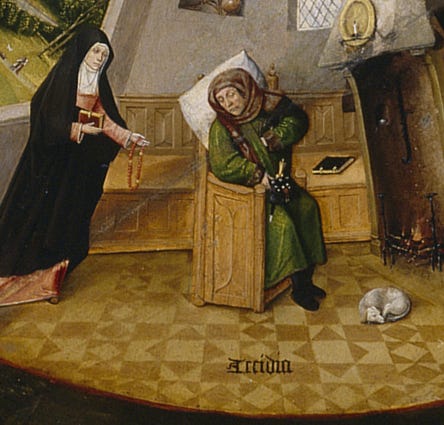
Why is Sloth Ranked as it is?
If Sloth is really boredom or sadness over a higher good, insofar as it conflicts with lower goods, it is hard to see how that’s a sin. How could being bored or being sad be a sin? This sounds more like low-grade depression than a moral failing! What gives, Aquinas?
I think you’ll be glad to know that Aquinas draws a relevant distinction here, differentiating types of sorrow:
We should note that we can consider spiritual apathy in two ways, since it is a sadness: in one way as the act of a sense appetite; in the second way as the act of the intellectual appetite, that is, the will. For all names of such dispositions as indeed acts of sense appetites designate emotions, but as acts of the intellectual appetite designate only movements of the will. And sin intrinsically and in the strict sense belongs to the will, as Augustine says. And so spiritual apathy, if it should designate an act of the will avoiding an internal and spiritual good, can have the complete nature of sin. But if we should understand spiritual apathy as the act of a sense appetite, it has the nature of sin only from the will, namely, insofar as the will can forbid such a movement. And so if the movement is not forbidden, it has some nature of sin but not the complete nature. (De malo q.11 a.1 resp)
I take his point to be as follows. The emotion of sadness itself isn’t a sin. The only way you get sin in the sensible emotion bit is if it is consented to by your will. (Maybe you are seeking attention; or maybe you are an emo kid1) But there’s no sin in the sensible appetite, the emotion itself. That sounds reasonable to me.
Thomas also gives us some advice about what to do about that sensible appetite of sorrow. In Summa theologiae I-II, q.38, he suggests that people burdened with sorrow seek some pleasures, weep and groan, experience the consolation of friends, contemplate the truth, or sleep and take a bath. This sounds like great advice to me. You can sniff the philosopher in him in that suggestion to contemplate truth to become happier.
Sloth is a capital sin, according to Aquinas, not because we love some particular thing too much and seek that particular thing excessively (that’s the excessive love portion of Mount Purgatory), but rather because you sorrow at a higher good. We unwant that higher good to such a degree that we are willing to do all sorts of other things, even sin by negligence, in order not to face the activities of that higher good. If you are bored out of your mind when you go to church, sad and frustrated at having to attend, even though you think, in your heart of hearts, that you ought to, then you might feel the urge to lie about being sick so as not to attend, or to cultivate worldly daydreams instead of worshiping, etc.
One way to differentiate the gravity of the Deadly Sins is by measuring the distance between what one’s heart is set upon and what it should be set upon. Remember our buddy Bob, whose arrow shows what he has his heart set upon. When last we checked, we saw that Bob’s heart wasn’t set upon God, but was instead set toward possessions:
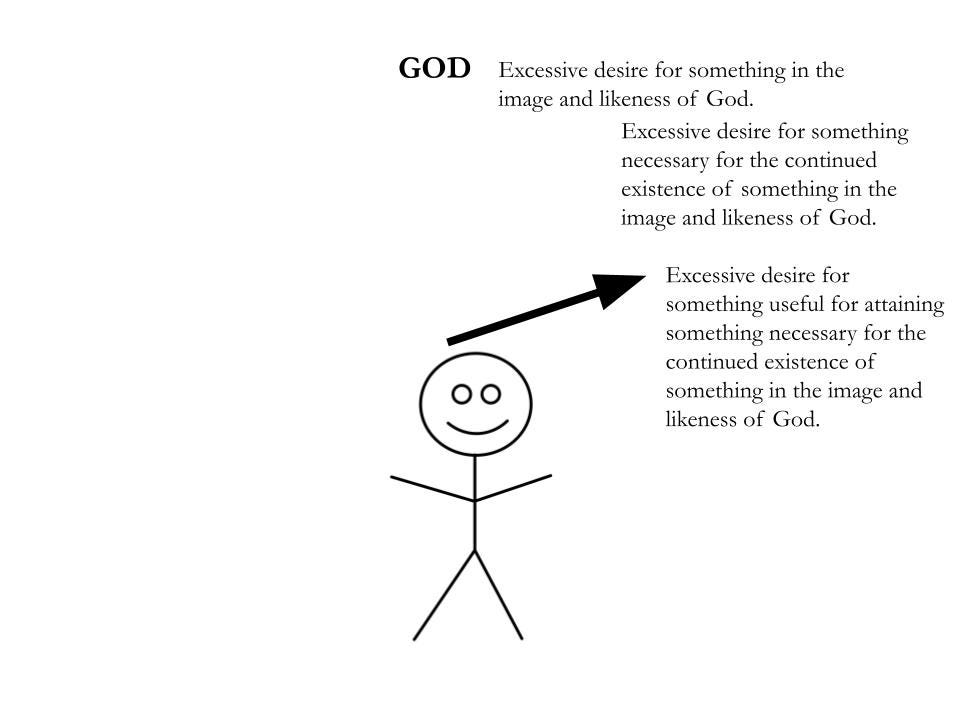
Such was Bob, his heart yearning more for the good of possessions than for God, even if grasping at possessions put enmity between him and God.
Here’s Bob now:
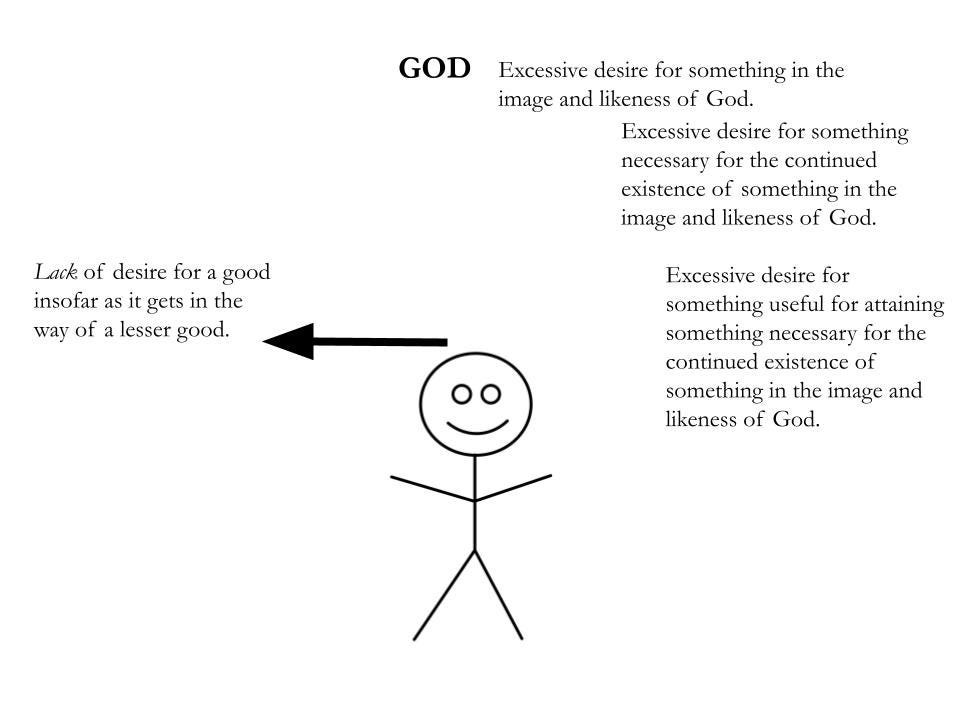
Bob’s ultimate good arrow is not set upon God, the genuine ultimate good. Indeed, it is not set upon any one good thing. He has descended beyond the sins of excessive love.
His heart is not set on something in God’s image and likeness, as in a typical case of Lust.
His heart isn’t set on something necessary for the continued existence of something in God’s image and likeness, as in a typical case of Gluttony.
His heart isn’t inordinately set upon the possession of some instrumental good, some good that is, at most, useful for attaining something necessary for the continued existence of something in the image and likeness of God, as in a typical case of Avarice.
No; his heart is not set on any good at all. Rather than desiring some good too much, he desires some good, the higher, spiritual good, too little.
In that respect, the state of Bob’s heart is far removed from where it should be. But as we will see as we go on, Bob’s got much farther he can descend.
Sloth’s Daughters
Gregory the Great lists six daughters for Sloth. They are:
1. Malice
2. Spite
3. Faint-heartedness
4. Despair
5. Sluggishness in regard to the commandments
6. Wandering of mind after unlawful things
While Aquinas discusses these daughters a bit in De malo, a better discussion comes in his Summa theologiae. You might think that Gregory misfired, Aquinas considers, because some of these daughters are common to many sins, for instance, our minds often wander away from lawful things, and we are often sluggish toward the real good. This isn’t the sole domain of Sloth.
Here’s how Aquinas defends Gregory, explaining the concepts along the way. When you are slothful, you both want to shun the spiritual goods that cause the sadness, but you also want to seek the carnal pleasures that cause you happiness. That seeking is wandering after unlawful things. Concerning the shunning, the spiritual goods can be related to in many ways. The spiritual goods can be seen as our end, in which case the daughter of Sloth is despair as we lose hope in attaining that end. The spiritual goods can be seen as the means to our ultimate good, in which case, in difficult matters we feel faint-hearted in undertaking those means, and in common matters we become sluggish. Sometimes we not only shun the spiritual good, but we also lead others in so shunning, in which case we engender spite toward spiritual goods. Finally, we are led to detest the spiritual good itself, which can be called malice.
And since I’m nothing if not a fan of a hierarchical representation of a conceptual terrain, here you go:
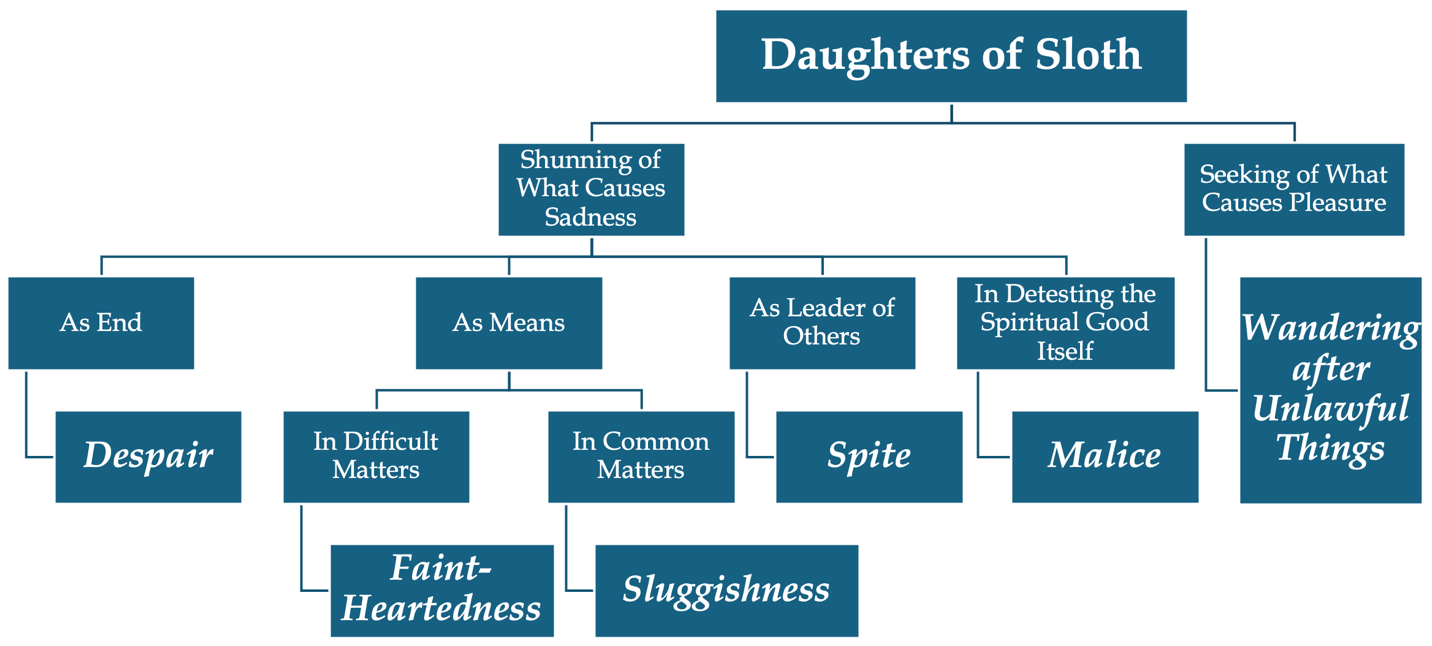
Next time we move on to the next sin in order of gravity: Envy. Stay tuned.
Is saying it is seeking sadness or it is emo like saying maybe it is a mammal and maybe it is a dog?
Same here - if there’s one that pwns me it’s this one…😕
There it is: my particular devil, my malady, my predominant fault, my sin.