
Condescension
An Undersung Virtue

Do you remember this picture of President Barack Obama giving a fist bump to the custodian, Lawrence Lipscomb?
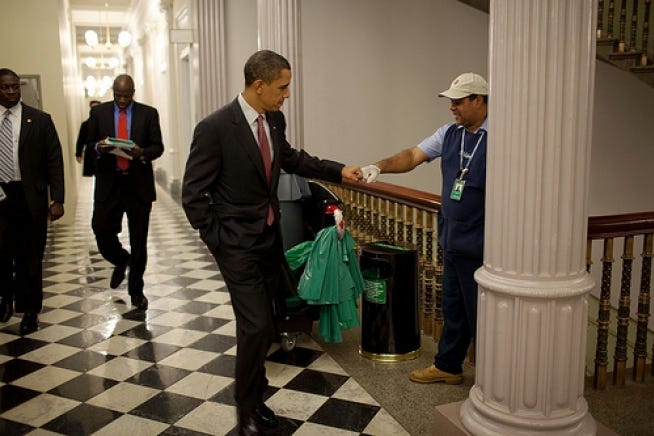
Lipscomb is coming up the stairs in his baseball cap and latex cleaning gloves. And there’s Obama, dapper as ever, coming out of a White House Forum. Obama stops for a casual sign of respect and solidarity with a fellow human. Even though he is leader of the Free World, the most powerful man on the globe, he still sees and values the humanity in Lipscomb. Obama isn’t afraid to come down from his high status for camaraderie, or, indeed, to encourage Lipscomb up to meet him. The symbolism in the picture, with Lipscomb ascending the stairs, is perfect.
That trait – the virtue of being willing and able to leave one’s own vaunted social status to interact on the same level as someone of a lower social status – that virtue used to be called condescension. Condescension! The etymology makes perfect sense – you come down (descend) to be with (con). And yet, the way the term is used these days, you’d think that Obama was a real jerk to Lipscomb if I said Obama was condescending toward him. And we needn’t rely on the merely hypothetical reception the term would get: my buddy Daniel Rubio commented on my Lustful Switcheroos post that absent-mindedly using the term condescension in the old sense has bewildered his audiences in the past.
Well, so be it. You won’t catch me plumping for a return to centuries-old language for its own sake. I’ve got higher things on my mind.
I don’t want to sing the praises of the word. I want to laud the trait. No matter what we call it, we all thought Obama’s action showed a good side of his character, and we still think it, even if we don’t use the word for it that our great-grandparents did. I come to sing the praises of the virtues, not the names we use to reference them. To paraphrase Juliet:
What’s in a name? That which we call a virtue by any other name would seem as sweet.
(I couldn’t make myself keep the “smell” in there. Could virtues smell? If so, which would smell the best? Probably cleanliness. Homework: which virtue would smell the worst? Which vice?)
The problem I seek to address, as I described in my post on Undersung Virtues, is our lack of concepts. We all want ourselves and those we love to be like Obama in this respect. Think of how disgusting it is when rich, spoiled children, having earned nothing on their own, mock someone in a service industry working hard to make ends meet. We try to inculcate an appreciation of the humanity of others in our children. But what do we call that trait? We surely don’t call it being condescending:
“Try as I might, I just can’t get condescension to take root in little Billy! Any suggestions?”
Indeed, the current meaning of “condescension” is just about the opposite of what we want to inculcate! There’s been a switcheroo.
But then, if “condescension” has been reassigned to another post in our contemporary lexicon, what’s the term we’ve replaced it with? What word do we use for this humanizing virtue, this feature we ardently want in ourselves and those we love, the opposite of which repulses us? I don’t see that we have a word for it, to our detriment. And why don’t we?! This is something well worth aiming for and praising! Such a conceptual shift without replacement leaves us impoverished.
Perhaps the word we have nowadays is egalitarian. Well, maybe. But I don’t think so. To my ear, that term names a philosophical view, not a virtue. You could hold an egalitarian view in principle yet remain disdainfully aloof from the peasants. In fact, I suspect that this combination is common. We pay lip service to the humanity and equality of the poor among us, yet like the most elitist aristocrat we don’t deign to look at them at the stop light. Theory and practice stay safely in their lanes.
No, I don’t think we have a good replacement term for what used to be called condescending. What a detriment to our moral diagnostic machinery!
Maybe we could made do using a negative term to ward off the gross trait that the spoiled kids show in their mockery. Maybe you encourage condescension-in-the-old-sense by discouraging condescension-in-the-new-sense. There’s a little bit of vertigo in that maneuver for those who know the history of the term, which group now includes you (sorry!), but it’s clear enough what the strategy amounts to. To get little Billy to do well, we push him away from doing poorly.
This isn’t a terrible move. It’s definitely important to name and distain vices. But this strategy misses out on something important. Think about Billy, whom you love and want the best for. You don’t merely want him to move from derision at those he sees as below himself to apathy or neutrality toward them. You want something more for him, don’t you? You want him to be welcoming, warm, and appreciative toward them. When you think about it, your heart isn’t set just on him stopping the bad, you want him to start doing the excellent. Merely encouraging him to knock it off isn’t pointing him toward your real goal. So: there’s a real need for the virtue term.
What about using a broader virtue term? Maybe we just want our kids to be good with respect to others, and this is a way of being good.
“Billy; be good!”
Is using a general virtue term enough to get at what we really want? What if I offered that to you as a sufficient strategy? I can hear you now:
To see why I agree with you, consider an analogy. Think of the many words we use for measuring strength in a substance that lay-folk run together but civil engineers keep distinct, and needfully so for their work. You and I might say that the concrete is strong, the aluminum is strong, the bulletproof glass is strong, this weave is strong, etc. But of course, as I just learned from Wikipedia, engineers must distinguish many types of strength, otherwise everything falls apart. These include:
Yield strength: “the lowest stress that produces a permanent deformation in a material”
Compressive strength: “a limit state of compressive stress that leads to failure in a material in the manner of ductile failure or brittle failure.”
Tensile strength: “a limit state of tensile stress that leads to tensile failure”
Fatigue strength: “a more complex measure of the strength of a material that considers several loading episodes in the service period of an object”
Impact strength: “the capability of the material to withstand a suddenly applied load”
Shear strength: “the strength of a material or component against the type of yield or structural failure when the material or component fails in shear.”
No doubt, there are many more notions of strength in engineering that didn’t show up on the lone page I word-searched. These notions of strength have different applications and uses. You’d certainly receive stern looks if you substituted yield strength for tensile strength in your calculations for bridge building.
Keeping track of all these different types of strength is hard for budding engineers. We could make it easier on them if we just revert back to the broader, more general terms they had before taking any engineering courses. Why not do that?
I think the answer is that it would be, to use a technical term, a total disasterbacle. The engineers definitely need a distinction between tensile and shear strength, and they won’t learn anything much of use if they stuck with just plain “strength” and didn’t disambiguate in important ways. After all, the methods for measuring and for increasing these various types of strength are different. If you told the engineer just to make the bridge stronger, he’d be at a loss for how to increase the trait you want, and even at a loss for what trait it is you want to increase.
What goes for building a bridge goes, too, for building your character. How to make your character better depends on what variety of betterness you are aiming at. Just like the engineers find utility in distinguishing varieties of strength so that they can measure and improve the specific things they desire in the structure, so likewise we engineers of character find utility in distinguishing different virtues (different character strengths) to measure and improve the specific traits we want to inculcate in ourselves and those we love. And whereas very few of us have any role in building a bridge, we all have a vital role in building our characters and those of people under our care (like our kids).
So, I don’t think a mere negative term or a more general positive term is sufficient for aiming ourselves toward the real desires we have about character. If condescension-in-the-old-sense is an excellence we ardently desire in ourselves and in those we love - and it is! - then we should have a name for it that we can use for target acquisition, exemplar identification, motivation, and exhortation. We don’t have one, since the previous term to do that work was forcefully relocated to the opposing team.
I’m taking suggestions. What should we call it these days? I asked Chat-GPT for suggestions, as that’s what we do these days. Here’s what it offered:
Candidate Terms
Gravitascent (from gravitas + condescend’s “scent/going down”):
Suggests someone of weight and dignity who stoops down warmly.Honorstance (from honor + stance):
The stance of honoring another, regardless of rank.Affidignity (from affable + dignity):
Warm approachability that affirms dignity.Humiliality (from humility + sociality):
The social grace of humility in interaction.Gracedown (plainspoken, evocative of the old sense of “stooping down in grace”):
A leader who shows gracedown is one who delights in lifting others up.
I don’t want to brag, but I bet we can do better. Though, credit where it’s due, Humiliality is fun to say! And maybe we have a contender for worst smelling virtue in Gravitascent?
What do you think? What should we call the trait we used to call condescension?
I think part of what's going on is that because our culture is more ideologically egalitarian than when condescension was recognized as a virtue, we are uncomfortable acknowledging the distinctions in status that are a prerequisite to regarding someone as virtuously condescending. To say "that was very condescending of you Billy, good job!" we must presuppose that Billy is somehow above whomever he condescended to. And we don't like doing that. It's the same phenomenon as almost everybody in the country calling themselves middle class.
(Edited for typos)
"Down to earth" as a phrase is in the vicinity of the old virtue, as is "unpretentious." Neither is quite right, of course. (this comment brought to you by the first two terms that occurred to me to describe the way Dean Zimmerman explains complicated ideas, which is the dictionary definition of the old virtue)