
Five Recent Publications
The Incarnation, NT Wright on Natural Theology, Patience, Perseverance, and the Virgin Conception.

Hi folks! I’ve got some fun news about a pile of recent publications I’ve written. Since they are relevant to things I’ve said on this Substack, I thought I’d bring them to your attention. And you’ll even be able to give me a bit of professional advice about where to list the first one on my CV, as it is stumping me.
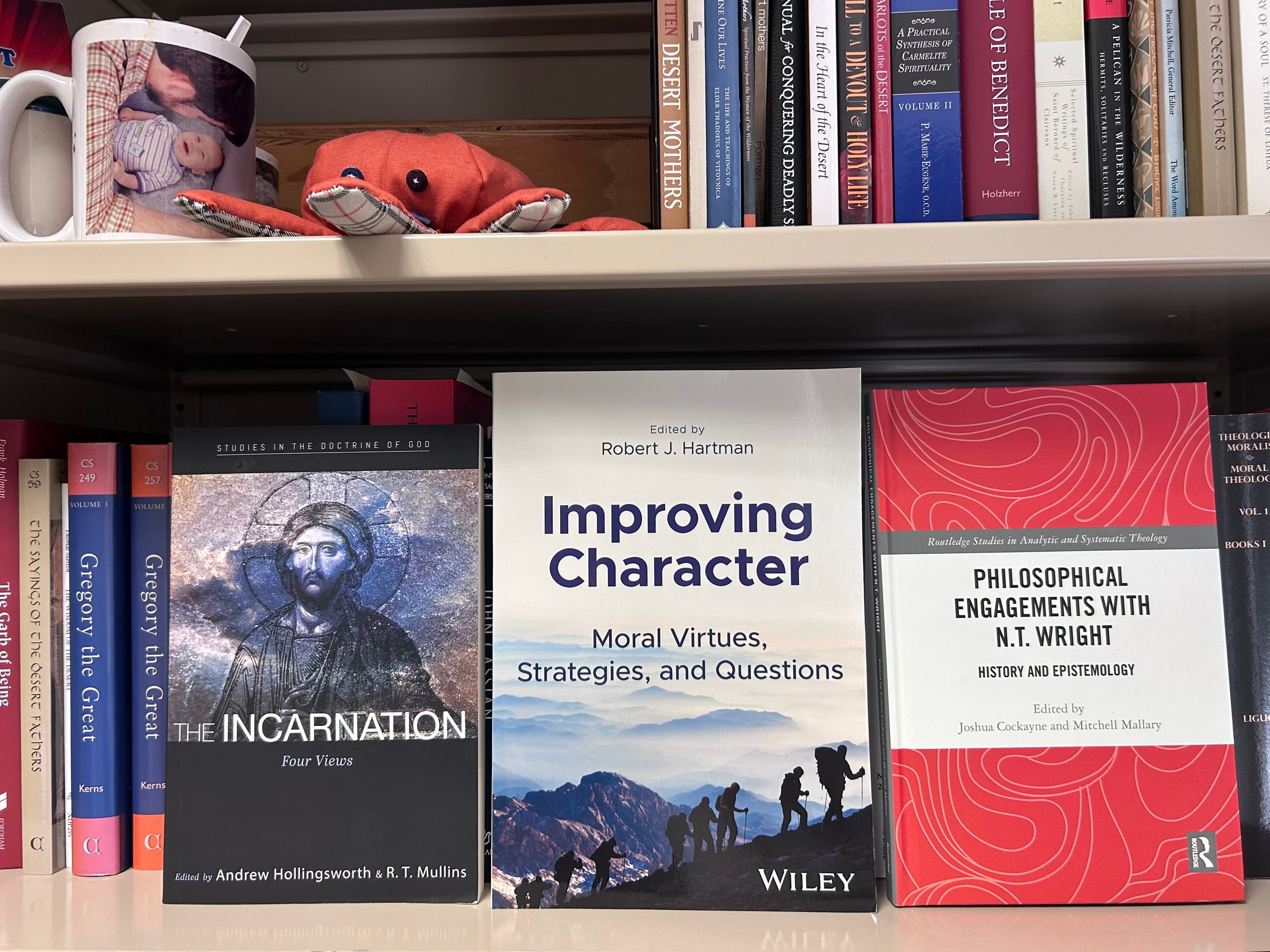
The Incarnation
The biggest of these projects is this one. I am one of the authors of the book, The Incarnation: Four Views.
This involved writing about 65 pages: my initial contribution, a reply to each author’s initial contribution, and then my final piece responding to the replies of the other authors.
I argued for a view I call "The Conciliar Narrow-Scope Negation Model.” Others, including at least one editor, preferred “Pawline Christology,” but I couldn’t bring myself to refer to my view with my own name. It seemed unseemly; though if you pressed me to explain why that would be unseemly and this Substack’s name wouldn’t be, I’d probably abruptly change the subject like Ira in Suicide Kings (language warning).
It is “Conciliar” insofar as it affirms everything taught in the first Seven Ecumenical Councils about the incarnation. That’s a necessary condition for a model’s being viable, in my view. For a free, concise description of what those councils teach about the incarnation, check out this encyclopedia article I wrote about Conciliar Christology.
My view is “Narrow-Scope” in how it understands some of the predicates applied to the divine person of the Word in the incarnation. For instance, it understands impassible not like this:
“A subject, s, is impassible if and only if it is not the case that s is causally affectable”
But instead like this:
“s is impassible if and only if s has a nature that is not causally affectable.”
2 refers to a nature, while 1 does not. But the difference that does the main work, you’ll see, is where the “not” goes. Does it have “wide scope,” negating all the stuff after the “if and only if,” as it does in 1? Or does it have “narrow scope,” negating only the last bit of the stuff after the “if and only if,” as it does in 2?
This matters, since the truth conditions come apart sometimes. Consider my long-deceased family pet, the dog Sport. “It is false that Sport is sitting” is now true, as he doesn’t even exist, and a necessary condition of his sitting is his existing. But move where the negation goes in the claim to later, “Sport is not sitting,” and that is false, since that claim requires that there be a thing, Sport, that is a certain way, non-sitting. And there is no Sport. The moral: wide-scope and narrow-scope negations can have different truth values.
If we understand “passible” modeled off 1, then it would be:
“s is passible if and only if it is the case that s is causally affectable”
Nothing can be both passible and impassible if we understand the terms as 1 and 3. For, it would have to be true that the thing is causally affectable and ALSO false that the thing is causally affectable. That can’t be. Not everyone believes that contradictions can’t be true. But here at Pawline Epistles we are classical logicians.
If we model “passible” off of 2, we get:
“s is passible if and only if s has a nature that is causally affectable.”
Provided that something can have two natures - and that’s a fair assumption in a book about models of the incarnation! - then, understood as 2 and 4, something could be impassible and passible. It would need to have a nature that is causally affectable, like a human nature, and a nature that is not causally affectable, like the divine nature. And that’s exactly what Christ has! If you’d like to see the mechanics of the view worked out in more detail than anyone ever asked for, here’s an open-source article in which I present it. It’s also in Chapter 7 of my In Defense of Conciliar Christology.
My contribution defends the narrow-scope view, saying that we can find evidence for such a view in the earliest Ecumenical Councils. As such, we can solve the philosophical problem of how a single person can be, as the councils say, both impassible and passible, or capable and incapable of death, without contradiction. He can be such if we understand the terms in a narrow sense, as 2 and 4. And the councils give us reason to do so.
Professional Advice Request
Where does one list this project on a CV?
It isn’t a lone article. It strikes me as misleading to call it 5 articles, as the responses are only about 3,500 words a piece. Is it listed as a book I co-authored? I’d think not. The main article is almost 9,000 words; the final reply to the objectors is around 4,000. So the total is just north of 23,000 words. Where does this thing go?!
NT Wright on Natural Theology
Back in 2019, before Covid was a thing, Faith and I were visiting Senior Fellows at the Logos Institute for Analytic and Exegetical Theology at the University of St. Andrews. While there, I sat in on a class on the Pauline Epistle, Ephesians, that NT Wright taught. He presented a truckload of Ancient Near Eastern context to help interpret the letter. It was a treat.
While there, I was also asked to write a contribution to a collection of philosophical engagements with his thought. The piece came out in this volume, aptly entitled Philosophical Engagements with N.T. Wright: History and Epistemology, edited by Joshua Cockayne and Mitchell Mallary. At $233.99, it is a steal! Or, at least, something like theft.
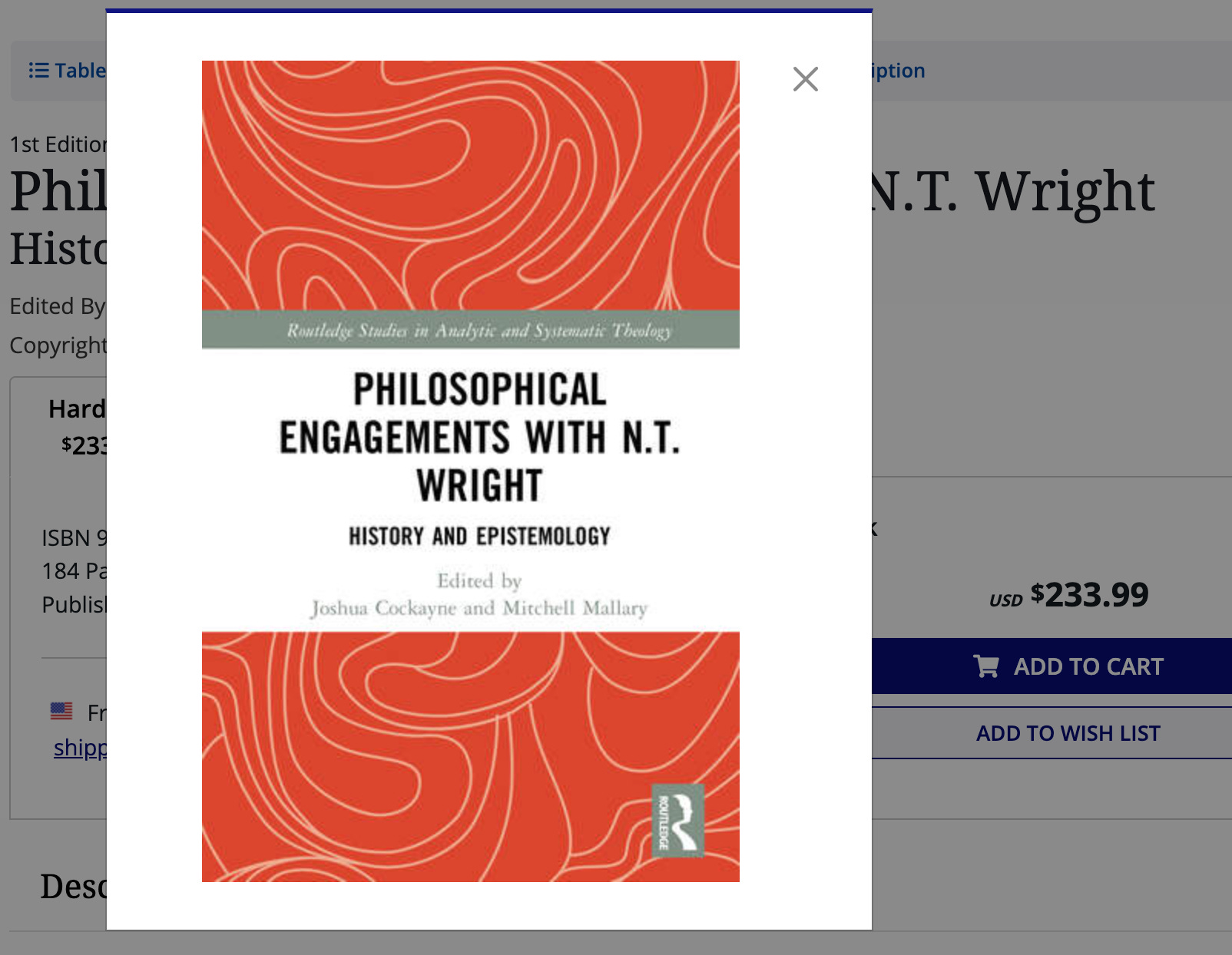
The article is The Data of Natural Theology and the Utility of History (and Philosophy). Here’s the abstract for the chapter:
ABSTRACT
In recent works, N. T. Wright has put forward an account of natural theology, most comprehensively in his book, History and Eschatology: Jesus and the Promise of Natural Theology (2019). In this discussion of Wright’s view of natural theology, I do three things. First, I discuss Wright’s conceptualization of natural theology. Second, I discuss what I see to be a two-step corrective he offers with respect to natural theology. I will argue that the first is an insightful corrective and most useful to the field; the second, on my view, looks to be an overextension. Finally, I discuss Wright’s conception of the tasks of history. Throughout, I draw parallels to the tasks of philosophy. Both disciplines, it seems to me, via different methods, have the same proximate ends when it comes to theology (whether natural or otherwise).
Patience
I co-authored a chapter on the virtue of Patience in this volume, aptly entitled The Virtue of Patience, edited by Matthew Pianalto and Sarah A. Schnitker.
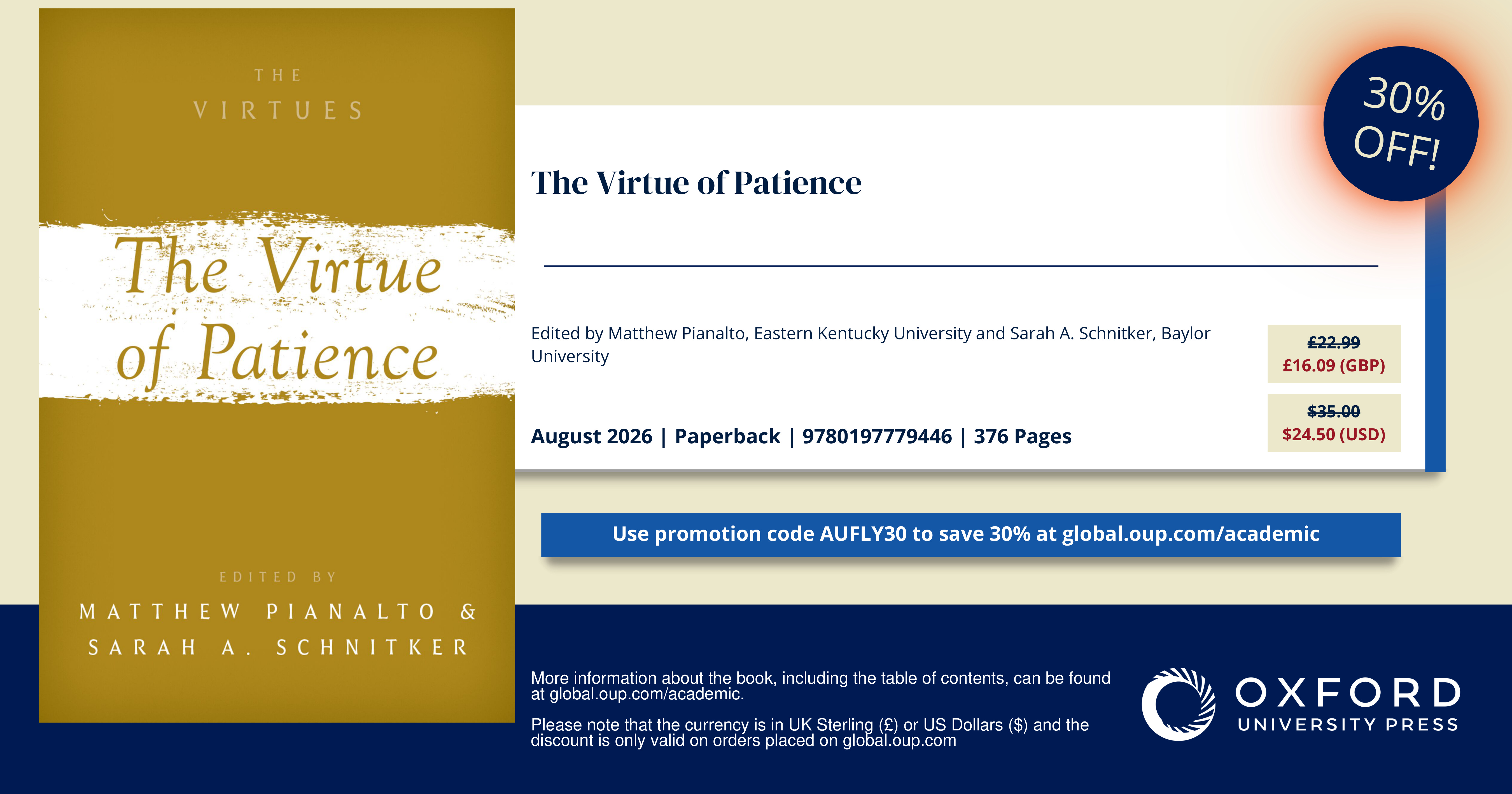
The article is Pathways to Patience: Christian Moral Wisdom and Goal Pursuit and is co-authored with Juliette L. Ratchford and Sarah A. Schnitker. Here’s the abstract for the chapter:
Abstract
This chapter showcases the interrelations between the understandings of patience in Christian moral wisdom and in contemporary psychological findings. Christian moral wisdom teaches that patience is interconnected with a variety of virtues, including meekness and courage, which address particular emotions. Recent psychological work has examined the emotion regulation strategies that are employed in regulation of particular emotions. Christian moral wisdom teaches the necessity of patience for attaining the Christian goal of union with God and receiving God’s promises, and contemporary psychology examines the necessity of patience for goal pursuit, too. The Christian tradition also emphasizes the importance of practicing patience alongside other virtues, which is reflected in psychological research on the counterbalancing relation of patience and courage. Likewise, both Christian moral wisdom and contemporary psychology suggest that reminding people of their goals is beneficial for their behaving patiently; Christian scripture suggests this, with Gregory the Great and Thomas Aquinas affirming it explicitly. Likewise, psychological findings indicate that self-transcendent goals may facilitate patience, helping people identify an ultimate, self-transcendent purpose as a prime direction for future intervention research. In addition, both Christian moral wisdom and contemporary definitions of virtue found in psychology and philosophy warn against measuring a character trait, like virtue, by reference to activities regardless of the motivations for those activities, even though empirical measurement remains challenging. Finally, understanding the ways humans might be patient with God is an important candidate for theological and empirical inquiry.
Folks who like research at the intersection of Christian Moral Wisdom and contemporary psychology will like this chapter. Take a look!
Perseverance
I authored a chapter on the virtue of Perseverance in this volume, entitled Improving Character: Moral Virtues, Strategies, and Questions, edited by Robert J. Hartman.
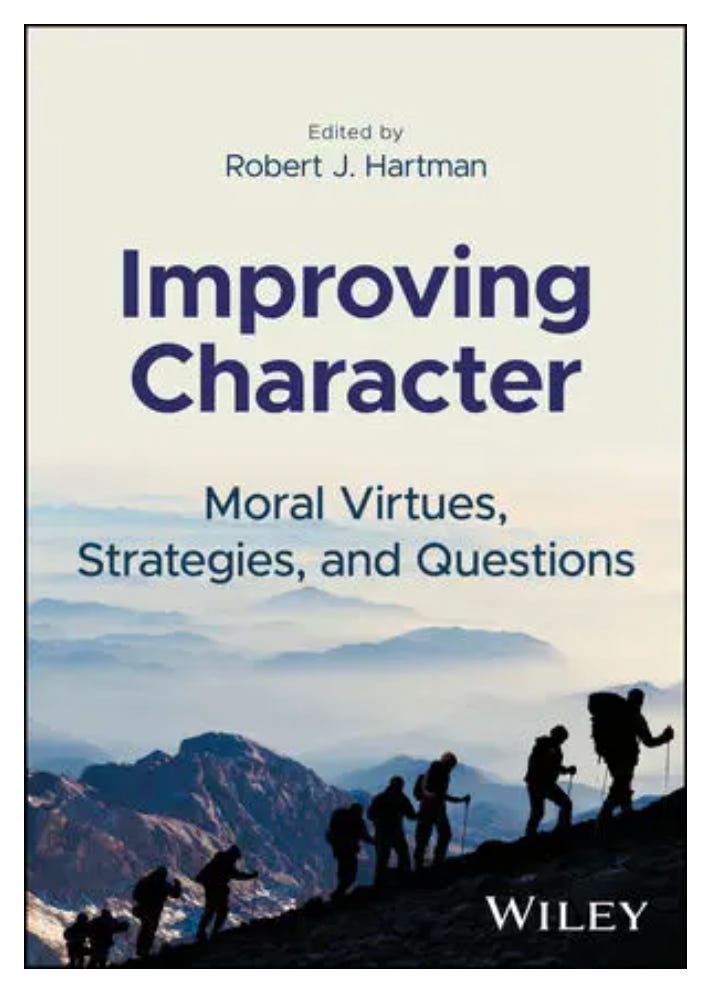
The article is aptly entitled Perseverance. Here’s the conclusion paragraph, which describes the main things I argue for in the piece:
Conclusion
Perseverance is the stable disposition to excellently endure external things that are natural to your goals. You persist well in learning the language, or in following your training schedule for the big race. Perseverance is unanimously praised across times, cultures, religions, and philosophies. The two main vices associated with perseverance are irresolution, which is the stable disposition to cease persisting when one ought to continue, and intransigence, the stable disposition to continue persisting beyond when one ought to stop. Three ways one might measure whether one is showing perseverance in a situation, rather than one of the vices, are to ask whether the perseverance is conducive to an appropriate ultimate goal, whether it is conducive to the health of your interpersonal relationships, and whether it is conducive to your fulfilling your obligations. Perseverance, as a form of excellence in persisting well, is essential for our flourishing insofar as flourishing requires us to persist against some obstacles, but also to cease enduring others.
This chapter isn’t so much about Christian Moral Wisdom, though those in the know about a Thomistic account of Perseverance will find themselves familiar to the main moves of the piece.
The Virgin Conception
Finally, I published an article in the inaugural issue of the journal, Triptych.
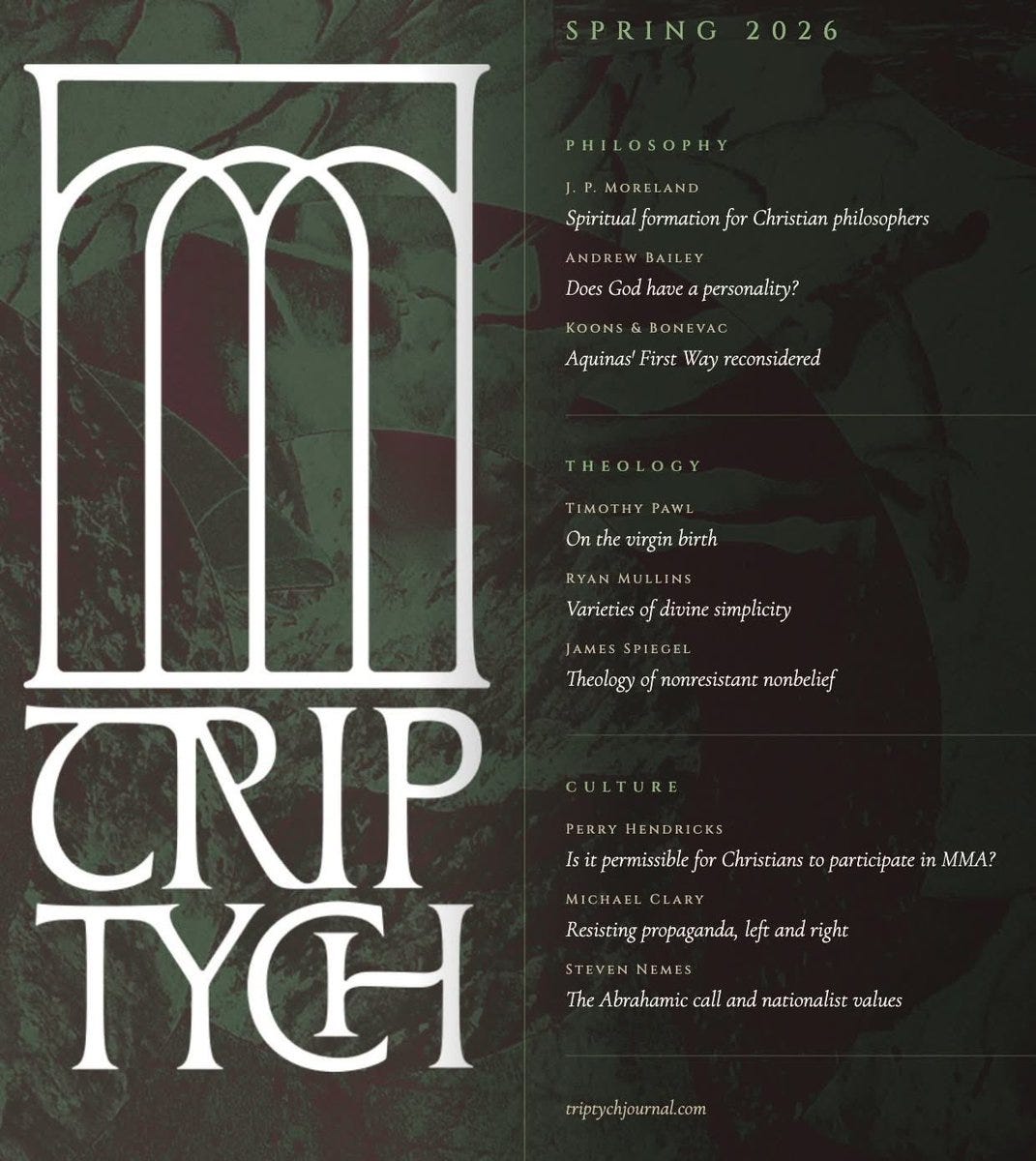
The article is entitled “The Virgin Conception,” and is in fact based on earlier posts on this substack, as well as on my book, Jesus and the Genome. Here’s a bit of the conclusion to show you what I’m doing in the article:
Conclusion
So, to summarize, here’s my take on this alleged tension between biological findings and the virgin conception. The opponent of the compatibility of Christianity and biological science argues something like this:
Premise 1: The Virgin Conception cannot happen by standard biological means.
Premise 2: Standard biological means are the only way the Virgin Conception could happen.
Conclusion: Therefore, the Virgin Conception did not happen.
I grant that the argument is valid – if the premises were true, the conclusion would be guaranteed to be true. Moreover, I grant the truth of the first premise, given my admittedly limited understanding of biological science. But I deny the truth of the second premise. And I charge the proponent of such an argument with committing the error of tacitly presupposing some third thesis, Naturalism, in the justification of Premise 2. Given that unspoken assumption, of course one can easily derive a contradiction. But that’s simply because Naturalism and Christianity are flatly at odds. The tension has nothing to do with the biology anymore. And so the tension doesn’t tell us anything about the incompatibility of Christian belief and the findings of biology.
That’s that! Thanks for reading!
On the CV, I would think it would go in the "book chapters" section, that seems closest to what it is imv, a bit beefier one
Why "Pawline Christology"? Why not "Timid Christology"? That way, it's less of a mouthful, but you're clearly not putting on airs?
What, you're too fancy to go by "Tim" nowadays?
Jerk.