
It's about time
Since you can count my contributions on one hand, I think this is overdue.

When I told Tim I’d contribute to this Substack last summer, I had good intentions and a good bit more free time than I do now. Having just made my way through Bede’s Ecclesiastical History of the English People, I planned to write a series of posts on the saint and venerable father of English history, and right away scratched something out about his hagiography. I audaciously called it “Part 1” and promised I’d write more, but that hasn’t happened.
You may have noticed I’ve become something of an absentee substacker. The time got away from me and there wasn’t enough of it in the first place. Readers, I will spare you the usual excuses. Except this one. Over spring break, I took a group of students on pilgrimage to Scotland and England-- to the Borders, Northumbria, and North Yorkshire. In other words, Bede country. (Planning the trip was the reason I’d picked up Bede in the first place. We traced lengths of two medieval pilgrimage routes, the ways of St. Andrew and St. Cuthbert, which are lined with important places from his book.) I was busy with preparations in the months beforehand, plus other big events at school on top of the usual work and family hustle. I am sorry for leaving you in the lurch. In the words of Eric B. and Rakim,1
It’s been a long time, I shouldn’t have left you, without some dope Bede to step to.
Bede knows a thing or two about long times. We think of him as an historian because of the impact of his Ecclesiastical History (which did cover a long stretch of time), but his deeper scholarly interests resided elsewhere, in scriptural study and a discipline called ‘computus.’ His most complete treatment of computus is his lengthy work, The Reckoning of Time, which is a pretty metal name.2 Computus is something like the scientific study of time for the sake of calculating the date of Easter. There’s no contemporary analog for it—computus draws on fields as diverse as astronomy, cosmology, mathematics, history, and biblical studies to plan out future dates for celebrating Easter. Bede’s paschal table sorted out 532 years worth of Easters! Along the way he explored things like the age of the earth and the very concept of time itself. Bede scholar Faith Wallis somewhere calls computus “calendar maintenance,” which is perfect because that’s also how I would describe the applied science that occupies most of Tim’s and my time: carting our kids to their daily activities. I’m not sure which version is more complicated.
Just kidding. Bede’s computus was obviously more complicated. The Church has puzzled over the date of Easter since very early on, and it’s been a source of debate and division ever since. Christians align Easter to the Jewish feast of Passover, but not precisely. By the 2nd century, many Christian communities were observing an annual celebration of Easter on a Sunday, where Passover is not fixed on a particular day of the week. In 325, the council of Nicaea fixed the official date for Easter on the Sundayafter the first full moon following the Spring equinox, so everyone could celebrate together. There, settled.
But not really, because no one agreed about how to calculate the Spring Equinox, which is kind of a messy business. The solar year has an annoying number of decimal places after 365, and lunar cycles aren’t the roundest of numbers themselves, so both lunar and solar calendars eventually get out of whack.…Just, not at the same rate. To get it right, Bede had to triangulate lunar calendars and solar calendars, and then transpose those onto calendar calendars, and I am now at the end of my dilettante knowledge and ability to explain anything more about computus.
The reckoning of time was even harder for Bede than it would be for us, because we have Arabic numerals at our disposal, a gift we mostly take for granted. He was working with Roman numerals, which in addition to being hard (for me) to remember, don’t line up by place-value when written out. Try to figure out how much time passed between the Great East Coast Blizzard of MDCCCLXXXVIII and the infamous Minnesota Halloween Blizzard of MCMXCI, and you’ll see what I mean. (It’s CII.)
To get around this, Bede devised a system of counting on his fingers so he could think and speak about dates and times that spanned thousands of years. His finger-reckoning was a kind of sign-language, fingers bent at various joints, held in a variety of spots in front of his chest, by which he kept track of and communicated the math more efficiently. His explainer on these signs would have made third-base coach Wendell Kim blush,3 not just because Bede’s signs outdo his in expressiveness, but also because Bede cites this weirdly bawdy mnemonic from St. Jerome to help his students remember which signs meant what. I’ll spare the details for the sake of my younger readers.4
The Reckoning is very long and includes lots of fascinating historical tidbits in its margins. I definitely did not read the whole thing. And it’s just one of three books he wrote on computus. (The first two were called, pretty uninformatively, On the Nature of Things and On Times.) His paschal tables became authoritative texts, and following his work in the field, computus became standard curriculum in monastic study for generations after him.
I have a hard time thinking about time on a practical and existential level, and I find the philosophy and physics of time incredibly intimidating. Keep your A-theories and B-theories of time, keep your time travel paradoxes to yourself. Don’t try explaining how time isn’t linear or absolute or whatever. I’ll just be over here calling time the sensible form of intuition and pretending like I know what that means.
But I do really like thinking about Bede thinking about time. The work of computus, the compiling and collating and figuring, could be done in an instant by AI now, the stuff of arid algorithms. I think Bede would still want to reckon for himself by hand if he were around today. He saw computus as a sacred study, a contemplative exercise that lets him take the long view of salvation history and simultaneously peer out into eternity. Citing Isidore of Seville, he says “Take number away, and everything laspes into ruin. Remove Computus from the world and blind ignorance will envelop everything….[Reckoning] began at the time when the creatures were made, that is, in the beginning of the world. For that was when number first began, as we read in Genesis, ‘And the evening and the morning were the first day.’”5
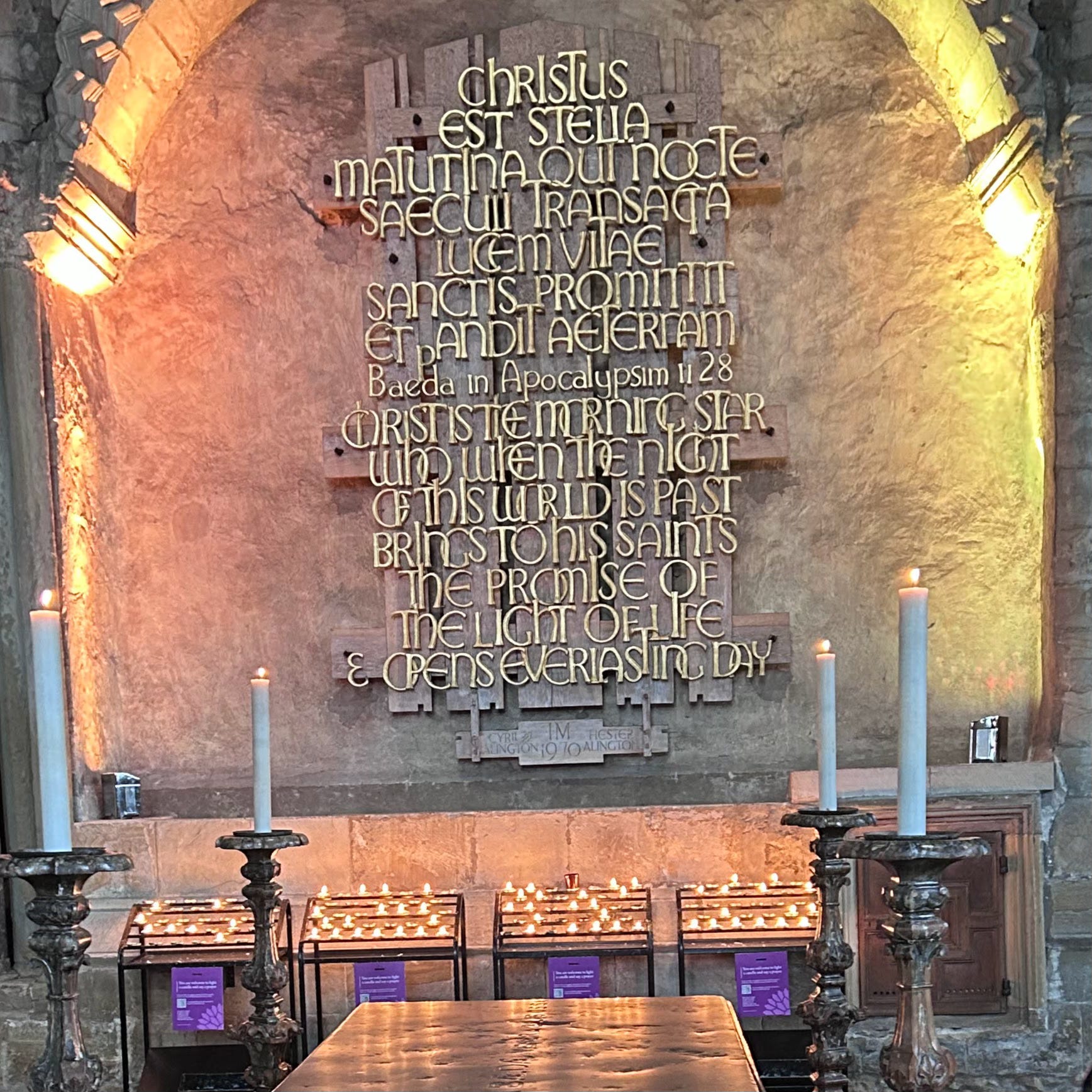
Theologically, Bede reminds us that time is a creature. It wasn’t there, and then it was. Suffused with divine wisdom, time was here unimaginably long before us and will go on, saecula saeculorum. Above his tomb in Durham cathedral, these words taken from his commentary of the book of Revelation that capture the point, “Christ is the morning star who when the night of this world is past, brings to his saints the promise of the light of life and opens everlasting day.”
We’ve just a small stretch of time in this mortal coil, and then we come face to face with that everlasting day and will be held to account. Thus, time is a gift not to be squandered. It’s something to be redeemed, which was ultimately Bede’s vocation. In the introduction to her translation of The Reckoning, Wallis says that Bede’sordination was “the last ‘event’ in his life. From that time forward, Bede’s life was one of sacred sameness, ruled not by change and chance, but by the stable rhythms of monastic time.” Bede says of himself, “’I have spent the whole of my life ... devoting all my pains to the study of the Scriptures, and, amid the observance of monastic discipline and the daily task of singing in the church, it has ever been my delight to learn or teach or write.”6 This life of sacred sameness suited Bede and gave him ample time and order for intensive prayer and study.
He taught and wrote about scripture, history, mathematics, cosmology, science, and orthography. He penned hymns and poetry. He was skilled with languages, and his commentaries and vernacular translations of the Bible made the faith accessible. Bede was somehow both a generalist and a specialist—a real Middle Ages Man if you will. At one point in the Reckoning he exhorts his students to dive deep into a time paradox by saying “Denique ut rei ipsius evisceremus interna.” Wallis colorfully translates this, “now to gut the bowels of this question!”7 If any of my analytic philosopher friends are looking for a catchphrase, that one is up for grabs.
I admire the meticulous care Bede brought to his scholarship, his deep sense of accountability to the evidence, whether that was historical, biblical, or scientific. He had his biases but was at least a little aware of them. He had no love for the Celtic exegetes and computers (computusers?) whose Easter dates he despised, but he had a deep devotion to Saints Aidan and Cuthbert who had followed the ‘wrong’ tables anyway, because he couldn’t deny their sanctity and love for the faith.8 His work was disciplined, in the truest sense of the word. Bede’s genius was not in creativity or innovation, but careful attention to detail and the ability to assimilate learning from a wide range of areas. His contemporaries and modern-day scholars alike note the unpretentious tone of his work-- he cared deeply for transmitting the truth and did not seem to care whether anyone was impressed by it or not.
My life is governed by a different rule than his, and I could never approach the breadth and depth of his learning. At least, not without abandoning my family for the convent and getting a much stronger prescription for my ADHD. Still, I can admire his scholarly virtues and aspire to imitate them in my little way.
St. Bede’s feast is coming up soon, on May 25. If you’re looking for a patron saint of calendar maintenance (aren’t we all), he could be your guy. He’s got a pretty sweet look on eternity now, so I’ll leave you with one more prayer I found at his tomb in Durham cathedral.
“I implore you, good Jesus, that as in your mercy you have given me to drink in with delight the words of your knowledge, so of your loving kindness you will also grant me one day to come to you, the fountain of all wisdom, and to stand forever before your face. Amen.”
May we all have a reckoning like that.
Ok, so the near-rhyme of this line actually comes from Timabland sampling Eric B. and Rakim, as featured on Aaliyah’s 2000 hit, “Try Again.” But that’s just the spirit I’m going for trying to get back into some writing, so it all fits together nicely.
Bede, The Venerable Saint, and Faith Wallis. The Reckoning of Time. Liverpool, Liverpool University Press, 2012.
Lest you think I know enough about baseball to come up with the name of a famous third base coach on my own, I don’t. Thank you, internet, for teaching me about “Windmill Wendell.”
If you are rushing off to find those details, I guess I’ll tell you it’s right on the first page of Ch. 1 of the Reckoning (p. 9), citing Jerome’s Adversus Jovinanum.
Bede, Reckoning xxiv-xxv
Ibid, xv
Ibid, 125
He also hated their haircuts but was able to overlook that too in a spirit of charitable ecumenism. That’s a weird story for another day.
Fascinating! Kinda of a sign language nerd, so will definitely have to check out a system used by a saint!
Oh, by the way the difference is CIII I think…which all the more proves the point I guess. Latin is a great language, but Roman Numerals were terrible.